Fine wine sellers pop their corks after Asian recovery stimulates higher prices


The economic recovery in Asia has prompted the popping of champagne corks in the fine wine market, where prices are recovering from last year’s sharp fall after a resurgence in interest from Asian buyers.
The highest priced lots at the recent Christie’s auction in New York, including $20,400 (£12,500) for eight bottles of 1982 Château Lafite-Rothschild, went to Asian bidders, while at the Sotheby’s auction in New York, a case of 1990 Le Pin went to an Asian buyer for $48,400, more than double the estimate.
Each of the nine Sotheby’s wine sales held during the first half of 2009, five of them in London, beat estimates, totalling $19.2 million against a top estimate of $14.8 million. Its sale in Hong Kong in April reaped a total of $6.4 million, more than double pre-auction estimates.
Stephen Mould, a director at Sotheby’s in London, said that Asian buyers were bidding increasingly at overseas auctions, making up 15 per cent of the UK market by number of buyers, but accounting for 32 per cent of the market by value.
A recent sale at Zachys in Hong Kong also experienced strong bidding. Jeff Zacharia, president of Zachys, said that he felt the wine auction market was “an early indicator that the worst is over”. He told Reuters: “Prices seem to have bottomed out at the beginning of the year and now there seems to be an upward momentum.”
Liv-ex, the London-based fine wine exchange, said its index of leading wines from the top 24 Bordeaux châteaux had enjoyed a 5 per cent increase in the first five months of this year. Last year the index fell by 13 per cent, having been ahead at the end of September, before the financial crisis.
Justin Gibbs, a Liv-ex director, said: “As far as we can tell, Asian buying has been sustained throughout the first half, and especially strong in the second quarter. Confidence levels in Asia seem pretty firm.”
Mr Gibbs said that while the European market was creeping up, the recession meant that UK wine merchants were still reluctant to take risks. He said that while the sell-off of wines in the wake of the banking collapse had now stopped, European collectors had yet to start rebuilding.
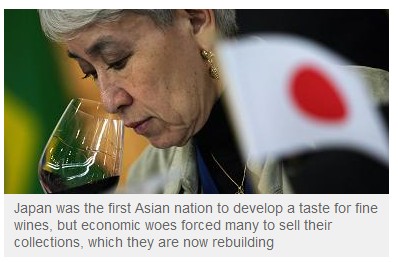
Japan, as the wealthiest Asian nation, was the first to develop a sophisticated wine market during the 1980s and 1990s. While Japanese conglomerates were snapping up high-profile American skyscrapers and golf courses, many of its richest executives were building impressive wine cellars.
At the same time, many Japanese were gripped by the belief that Beaujolais Nouveau was a sophisticated brand and took pride in the fact that the first bottles of each year’s crop went to Japan.
Even though the average Japanese diner now has a decent palate for wines, the country still goes dotty for Beaujolais. Mercian, the largest importer, expects to sell 64,000 cases this year, but has managed to take the experience even more downmarket by bringing in about 5,000 cases of plastic bottles to save on shipping weight.
Recently, the economic boom in China has created significant demand for fine wine among the new generation of entrepreneurs. The scrapping last year of the punitive duty regime has also turned Hong Kong into a potential market, releasing huge pent-up demand.
Although last year’s economic woes forced some of Asia’s new fine wine enthusiasts to sell their collections to raise cash, the recovery has prompted many to return, attracted not only by the annual compound growth of 12.6 per cent recorded by Liv-ex over the past 20 years, but also by a growing taste for drinking the finest wines.