Pemberton


Overview
Pemberton, in the heart of Western Australia’s south-west, is "karri country". The tall, majestic trees abound, forest upon forest, in national parks, amid creeks and rivers, wetlands and waterfalls, and on hills and dales. Pemberton also contains some of the state's richest farmland.
The Big Picture
Named after and centred on the town of Pemberton, this richly timbered region was first planted experimentally in 1977, with commercial vineyards following in 1982. The region is situated in the lower south-west of Western Australia, west of the Great Southern region and south-east of the Margaret River.
The area under vine has grown exponentially in the past ten years and this has seen the region become known as an area of influence in the state's premium wine sector through the production of high-quality fruit. Pemberton wines are now exported to more than 20 countries.
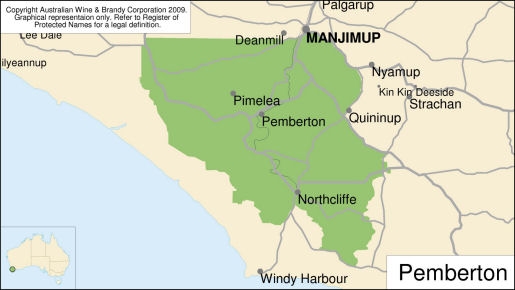
Pemberton Wine Region
Climate
Pemberton is cooler than neighbouring Manjimup, with fewer sunshine hours, more rainfall (except in January and February) and greater relative humidity, although temperature variability remains about the same.
Pemberton has a higher heat degree day summation (though only by five HDD) and more sunshine hours (1623 to 1535), as well as heavier rainfall and greater relative humidity. Because Pemberton is nearer the sea, the mean annual range is lower than for Manjimup; 8.55ºC (45.68ºF) compared to 9.7ºC (49.46ºF).
As a result of the high annual rainfall, a number of vineyards do not use irrigation, but the very pronounced winter/spring dominance can lead to stress late in the growing season if subsoil moisture diminishes.
Soil
Some 85% of the Pemberton region remains under native vegetation, with magnificent marri forests in the northern half, moving to karri in the south. There are two major soil types. The first are the lateritic gravelly sands and gravelly loams overlying medium clay with moderate water retention capacity. These moderately fertile soils are found on many of the higher slopes around Pemberton. The second soil is the more fertile karri loam – a deep red fertile soil which was formed directly from the gneissic country rock and which, together with the abundant winter and spring rainfall, leads to vigorous growth.
Wines
Chardonnay: Not only is this the most widely planted variety, it is clearly the most successful across the entire region in terms of style and quality. At its best, it produces opulently flavoured and structured wines, with an almost creamy texture, which respond well to the generous use of high-quality French oak.
Merlot: Either as a varietal in its own right, or blended with Cabernet Sauvignon, Merlot impresses, with good varietal character and mouthfeel.
Pinot Noir: Great faith has been placed in this variety but the results to date have not been consistent in table wines. Substantial quantities of both Pinot Noir and Chardonnay are used for sparkling wine, with good results in each case. Perhaps the region is too warm, but these are still early days. Some good Pinot Noir has been made but work remains to be done, perhaps with clonal selection and/or site selection.
Vital Statistics
| Map Coordinates | 34° 27'S |
|---|---|
| Altitude | 174 m (570 feet) |
| Heat degree days, Oct-Apr | 1497 (cut off at 19ºC (66.2ºF) but otherwise not adjusted) |
| Growing season rainfall, Oct-Apr | 340 mm (13.4 inches) |
| Mean January temperature | 19.6°C (67°F) |
| Harvest | Early Mar-Mid Apr |