Manjimup


Overview
Located in the heart of Western Australia's south-west among towering forests, Manjimup enjoys an outstanding reputation for its valued food crops; from prized, highly-priced truffles and a range of prime fruit and vegetables to high-quality wines.
The Big Picture
Named after and centred on the town of Manjimup, the region is immediately north of the Pemberton region, extending 20 kilometres (12 miles) to the west, 60 kilometres (37 miles) east to Perup, and 20 kilometres (12 miles) north to Wilgarup. Manjimup has red gravelly loams and an elevation of 200 to 300 metres (656 to 984 feet), while Pemberton is lower, with heavier black and much less gravelly loams.
Majimup’s viticulture and wine foundation began with research by the Department of Agriculture in the mid 1970s that included planting trials and detailed climatic investigations. Results identified the area for its potential as a leading grape growing region.
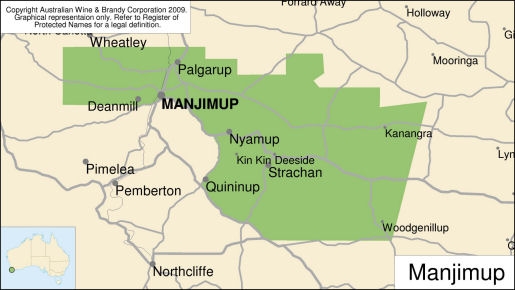
Manjimup Wine Region
Climate
The climate is influenced by the Indian and Southern oceans. It has some similarities to Margaret River, although being at a higher altitude it is more Continental. Cold winters provide true vine dormancy, while plentiful spring rainfall promotes good budburst and early growth. The relatively dry but stress-free summer and autumn conditions are no less favourable. Even temperatures during the ripening period ensure intense fruit flavours in the grapes for premium wine production.
Soil
The best soils of the region belong to the Kennan-Queenup series of sandy, gravelly loams created over millions of years by the erosive effects of the Warren River and its tributaries. An ironstone lateritic gravel layer several metres below the ancient surface has eroded so that the gravel has been mixed with red soil formed from the underlying granite to produce a red, gravelly loam.
As with the adjacent Pemberton region, large areas are heavily forested and, on average, only 25% of the region is suitable or available for viticulture. On the other hand, to the extent that irrigation is necessary, there is an abundance of clear, salt-free water available from the streams and rivers that flow throughout the summers.
Wines
Chardonnay: All other white varieties are dwarfed by this grape and there is little or no likelihood of much change in the future. The wines are elegant, light to medium-bodied, with the melon, citrus flavours of the cooler grown Chardonnay. It is still to be seen whether more mature vines will bring increased structure and intensity to the wines.
Verdelho: This wine has great freshness and zingy acidity here, yet it retains its tropical flavours and rounded mouthfeel.
Cabernet Sauvignon and Merlot: Dr John Gladstone has observed that both mean temperatures and sunshine hours are very close to those of Bordeaux, although temperature variability is a little greater and humidity a little less. He went on to say: "The wines produced from appropriate grape varieties should be very much in the mainstream of Bordeaux style." It is thus no surprise to find that Cabernet Sauvignon and Merlot dominate the plantings and that some very appealing and elegant Cabernet Merlot blends have been produced.
Pinot Noir: Quality and style will be strongly dependent on vintage, but it has already been demonstrated that, if conditions are favourable, Pinot Noir with good varietal character and ample weight and texture can be achieved. Restricting the yield, berry size and bunch weight will be of paramount importance.
Vital Statistics
| Manjimup | |
|---|---|
| Map Coordinates | 34° 26'S |
| Altitude | 200-300 m (656-984 feet) |
| Heat degree days, Oct-Apr | 1492 (cut off at 19°C (66.2°F) but otherwise not adjusted) |
| Growing season rainfall, Oct-Apr | 279 mm (11 inches) |
| Mean January temperature | 20.05°C (68 °F) |
| Relative humidity, Oct-Apr, 3 pm | Average 48% |
| Harvest | Mid Mar-mid Apr |