Mudgee


Overview
Standing on the small hill behind the Montrose Winery it can readily be understood why the original Aboriginal inhabitants named this part of Australia Mudgee, meaning Nest in the Hills. With a viticultural history that stretches back to 1858, Mudgee has played a key role in Australian viticultural history. Although primarily a producer of robust and deeply coloured red wines, Mudgee was the cradle in which a particularly good clone of Chardonnay lay unrecognised for over 50 years, a clone which some believe may have been a descendant of the Chardonnay introduced to Australia in 1832 by James Busby.
The Big Picture
The beautifully soft and intimate nature of much of the countryside around Mudgee is fashioned by the outer rim of hills which create the "nest " and the smaller hills within that perimeter that give rise to a panorama of mini vistas with ever more valleys nesting in their midst. Overall, however, though the slopes are gentle, all this beauty does have its limitations, particularly in the form of frost-prone pockets and hollows.
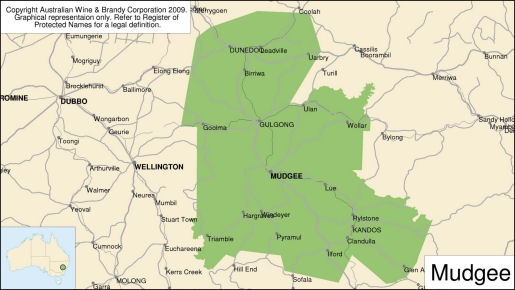
Mudgee Wine Region
Climate
Situated on the western slopes of the Great Dividing Range, Mudgee has a very different climate to that of its neighbour on the coastal side, the Hunter. Spring frosts and cold nights delay budburst; rainfall and humidity are lower; sunshine hours are greater; and irrigation is essential on all but the most favoured sites. This is by no means a cool region. The summer and autumn days are very warm, and harvest is four weeks behind the Hunter.
Soils
The brownish coloured soils are typical of those found through the majority of the wine regions of eastern Australia; slightly acidic or sandy loam over neutral clay subsoils, but both topsoil and subsoil have the advantage of being quite well drained. Yields have been restricted more by inadequate water for irrigation than by any deficiency in the soils or its structure.
Wines
Chardonnay: This is the predominant white from the region and is consistently good. The flavours are usually in the peach, melon, fig spectrum but often citrus and grapefruit characteristics emerge, particularly where the maker employs barrel-ferment techniques. The wines show their best varietal character in the second and third years but do go on to develop into rich and honeyed regional styles over a much longer timeframe.
Semillon: It is unfortunate that this Semillon lives in the shadow of the Hunter. The styles are similar, as is the capacity to age gloriously in bottle for up to 20 years. Riesling can develop equally well if made in a cool, dry year.
Cabernet Sauvignon: This variety makes Mudgee's best wines, usually as a 100% varietal but sometimes blended with Merlot or Shiraz. The wines have tremendous depth of colour and hold their purple-red hues for longer than those of the Hunter, turning brick red at seven to ten years of age. The generous flavours reflect the warm climate; a melange of tastes of red berry, dark chocolate and, sometimes, eucalypt and peppermint. The tannins are almost invariably pronounced but are not excessively astringent, for they are balanced by the generosity of the fruit.
Shiraz: These wines can be somewhat schizophrenic. Some are determined to out-Hunter the Hunter, with strong earthy, tarry, leather characters, while others are much cleaner and closer to Cabernet Sauvignon, with lush red berry fruits and hints of chocolate. Shiraz is frequently blended with Cabernet Sauvignon, sometimes with Cabernet and Malbec, almost always to very good effect.
Fortified Wines: A miscellany of styles is made, all with both local and tourist appeal.
Vital Statistics
| Mudgee | |
|---|---|
| Map Coordinates | 32° 36’S |
| Altitude | 450-600 m (1476-1968 feet) |
| Heat degree days, Oct-Apr | 2050 (cut off at 19ºC (66.2ºF) but otherwise not adjusted) |
| Growing season rainfall, Oct-Apr | 360 mm (14 inches) |
| Mean January temperature | 22.9°C (73.2°F) |
| Relative humidity, Oct-Apr, 3 pm | Average 42% |
| Harvest | Late Feb - Late Mar |