Orange


Overview
Initially known as the Central Highlands, the Orange region, centred on the slopes of Mount Canobolas, has long been an important orchard area producing apples, pears and cherries. An experimental viticultural station was established at nearby Molong in the 1940s, but vines were first planted commercially in 1980.
The Big Picture
Due to restricted opportunities for irrigation, major vineyard development has slowed since 2000 and much effort is now being put into raising the profile of the region on the national and international stage. The region is home to many small premium operators.
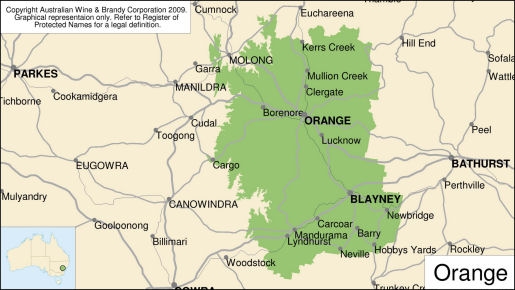
Orange Wine Region
Climate
The climate is strongly influenced by, and largely dependent on, elevation. Overall, mild to warm midsummer mean temperatures, seldom rising above 32°C (90°F), are offset by cool to very cool nights during the growing season. The rainfall predominates in winter and spring while the three driest months are February, March and April, making supplementary irrigation highly desirable. Wind is both friend and foe. On the one hand it helps to reduce the major climatic threat of spring frosts, thus making a north-easterly site exposure desirable. On the other hand, it interferes with fruit set on sensitive varieties such as Merlot. Other than spring frosts and climatic aberrations such as light snow in December, the major threat is from birds, which relish the extension of their diet.
Soil
The undulating countryside is not only very attractive but is of fundamental importance in determining site selection. The soils vary widely, reflecting the different geological strata of the parent rock but falling into four main groups. The first are the well drained, friable, deep red-brown clays derived from basalt that are found near Mount Canobolas. Second are the deep red-brown, yellow-brown clay loams of mixed origin, including volcanic ash. Both these two soil groups promote considerable vigour. The third is a red-brown podzolic clay loam of medium vigour overlying a medium clay and shale base interspersed with gravel, which assists with drainage. Finally, there are patches of terra rossa associated with visible limestone at the lower elevations.
Wines
Chardonnay: As in so many newly developed regions, Chardonnay is by far the most important wine. The style is a neat balance between the fleshy, rich, quick developing warm climate wine and the ultra fine, slow developing, citrus and cashew style of very cool climates. Melon, fig and nectarine flavours are set in a wine of medium weight and pleasantly firm acidity, responding well to but not relying on the subtle use of oak and malolactic fermentation. Carefully made regional styles respond well to medium-term cellaring of four to five years.
Riesling: Limited quantities of ultra-late picked Riesling are made from time to time. One was made from a picking on July 5, long after winter frosts and snow had arrived, and fully deserving the "Ice Wine" epithet.
Sauvignon Blanc: Intense tropical fruit flavours develop when grown at high elevation above 750 m (2460.63 feet). The more vigorous soils also produce fruit with an herbaceous character that complements the strong fruit flavours.
Cabernet Sauvignon/Merlot: Usually blended, but sometimes produced as single varietal wines, these leave no doubt that the Orange region has a temperate climate. The flavours run through the herbaceous and earthy spectrum with dark berry sweetness. They are of medium weight and body and have fine tannins. When considered by themselves they recall in their structure the better Australian cool-area wines. They can also be very effectively blended with wines from warmer regions such as Mudgee, the Hunter Valley and Cowra.
Shiraz: This is a recently planted variety showing true varietal flavours and exceptional colour. As in many other regions of Australia, Shiraz is the most widely planted variety in Orange.
Vital Statistics
| Orange | |
|---|---|
| Map Coordinates | 33º 15´S |
| Altitude | 600 - 900 m (1968 - 2952 feet) |
| Heat degree days, Oct-Apr | 1200 - 1309 (cut off at 19ºC (66.2ºF) but otherwise not adjusted) |
| Growing season rainfall, Oct-Apr | 440 mm (17.3 inches) |
| Mean January temperature | 19.9ºC (67.8°F) |
| Relative humidity, Oct-Apr, 3 pm | Average 47% |
| Harvest | Mid Mar - early May |