Cowra


Overview
The Cowra region is home to over 40 vineyards, from small boutique producers to large industry players. Covering 1250 sq km, the Cowra Wine Region is defined by its warm days, cool nights and dry late summers, which provide perfect conditions for ripening wine grapes.
The Big Picture
Despite sporadic growth since the Cowra Estate planted its first vines in 1973, there has been enormous growth in the importance of this region. The 1990s was a decade of major expansion, with a number of larger companies, notably Rothbury and Richmond Grove, and boutiques such as Brokenwood aggressively planting vineyards. It is primarily a white wine region that specialises in full flavoured, moderately priced Chardonnays.
The Cowra region boasts 11 cellar doors, and just over 20 wine labels bear the Cowra name. The local vineyard association has prioritised environmentally sustainable practice, with an aim to produce wines of regional character with the least environmental impact of any wine region in Australia.
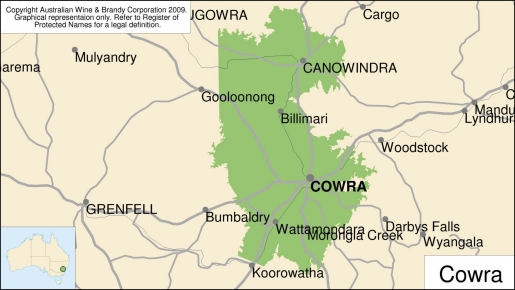
Cowra Wine Region
Climate
The climate is warm and dry, with the mean January temperature of 23.55ºC (74ºF) at Cowra Airport. Growing season rainfall is relatively moderate but relative humidity is low, reflecting the Continental nature of the climate. Spring frosts require appropriate site selection.
Soil
The vineyards are situated on gentle slopes within two valleys cut into the western side of the Great Dividing Range by the headwaters of the Lachlan and Belubula rivers, which converge at Gooloogong. The soils are brownish loamy sand to clay loam on the surface, with red clay subsoils. They are moderately acidic and vary from low to moderately fertile.
Wines
Chardonnay: By far the most important wine of the region, Chardonnay is invariably generously flavoured. In younger wines, yellow peach and ripe fig flavours tend to dominate and a degree of French oak influence is frequently encountered. However, some older wines of this variety are demonstrating a capacity to develop into ultra-rich, golden, honey and buttered toast styles.
Other White Wines: Semillion, Sauvignon Blanc and Verdelho are the other most commonly encountered white wines, with both variety and region specified on the label. Verdelho seems well suited to the region. Riesling and Gewürztraminer, too, are growing in quantity and reputation.
Shiraz: With increased age of vines in the area, the red wines are starting to show some depth of flavour and colour. Shiraz has performed extremely well, with the wines showing ripe fruit characters as well as some earthy and peppery notes. Some experimenting has been done with Shiraz/Viognier and this is showing promising results.
Cabernet Sauvignon and Merlot: These show the full expression of ripe fruit characteristics of dark berries, chocolate and sometimes eucalypt . The tannins are smooth and carry the fruit of the wine well. They are renowned for their easy drinking and approachable syles.
Other Red Wines: Some success is being seen with Petit Verdot, Sangiovese, Grenache and Mouverdre. Some of these are used as stand-alone varietals while others are used with blends such as the GSM.
Vital Statistics
| Cowra Airport 1966-2003 | |
|---|---|
| Map coordinates | 33° 57’ S |
| Altitude | 300-380 m (984-1246 feet) |
| Heat degree days, Oct-Apr | 2130 (cut off at 19ºC, 66.2ºF, but otherwise not adjusted) |
| Growing season rainfall, Oct-Apr | 370 mm (14.5 inches) |
| Mean January temperature | 23.5ºC (74ºF) |
| Relative humidity, Oct-Apr, 3 pm | Average 39% |
| Harvest | Early Mar - Early Apr |