Southern Highlands


Overview
The Southern Highlands form part of the Great Dividing Range, sitting between 500 and 900 metres (1640 feet and 2952 feet) altitude and centred on the towns of Mittagong, Bowral and Moss Vale to the south-west of Sydney. Like the Blue Mountains to the north, this area has long been a favoured destination for tourists seeking respite from the muggy heat of coastal Sydney.
The Big Picture
The 19th century history of the Southern Highlands region mirrors that of many other parts of Australia; a search for suitable grazing land, then a period of mineral exploitation (in this instance, iron) and associated industrial development, the arrival of the railway and then tourism.
Due to the presence of rich volcanic soil and a bounteous rainfall, grazing, horticultural and vegetable crops have always been popular with landholders in the district. Robertson is renowned for its potatoes. Other areas are equally famous for pome fruits and these days, in addition to grapes, olive groves are becoming more widespread.
Though there are records pointing to table grape vineyards and a modest wine production of 4300 litres (1135 gallons) in the Berrima district in 1886, there was little viticulture during the early 20th century, and the current wine history of the region dates only from the 1980s, when the Joadja Vineyards and Winery were established.
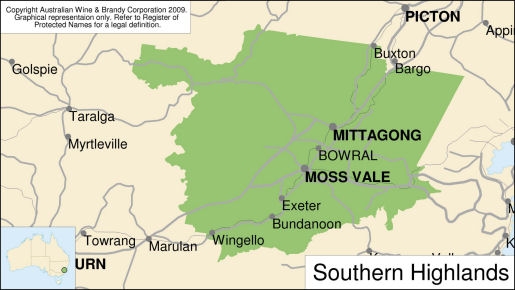
Southern Highlands Wine Region
Climate
Generally the region is cool, moist and slightly humid, and can be characterised as having a moderately Continental climate with mild summers and cool winters. Rainfall is evenly distributed throughout the year, varying from heavy (1664 mm or 65 inches) in the east (Robertson on the Illawarra escarpment) to moderate at Joadja, with 832 mm (32 inches) north-west of Berrima.
Viticultural hazards include hail, frosts during April and attack by rabbits, hares, ducks and wallabies on young vines and by birds on un-netted vines at harvest time. Fungal diseases, including downy and powdery mildews, are also present and require sulphur or copper-based sprays for control. Botrytis could also present problems in very warm vintages.
Soil
The principal viticultural soils are those derived from basalt (red and brown krasnozems and red earths) and shale (red and brown podzolics and brown earths). Both soils incline to acidity, which may be corrected by the addition of lime. Krasnozem soils promote vigorous growth but are free-draining; the red podsols, common throughout south-east Australia, are less fertile and do not drain as well. There are also some sandstone-derived yellow earths. The vineyards are situated between 500 and 700 metres (1640 to 2296 feet) altitude.
Wines
Chardonnay: Yet another of Australia’s cooler Chardonnay areas, the region makes both unwooded and wooded styles in melon-lime-citrus mode, sometimes even with a touch of green apple. Oak handling is light and skilful; acidity is generally good, auguring well for quality maturation.
Riesling: Riesling is showing promise, with floral citrus complexities in young wines and touches of honey and toast in older wines.
Sauvignon Blanc: These wines are very much in the general run of good cool-area Australian Sauvignon Blanc; light, smoky, grassy traits on nose and palate with good acidity.
Cabernet Sauvignon and Blends: The Southern Highlands is very likely to be an area in which Cabernet Sauvignon and its related varieties will perform better in warmer years. At present it is producing medium-bodied wines showing light berry and briar characteristics, mostly off young vines.
Vital Statistics
| Map Coordinates | 36º 27´ S |
|---|---|
| Altitude | 600 - 750 metres (1968 - 2460 feet) |
| Heat degree days, Oct-Apr | 1330 (cut off at 19º C (66.2º F) but otherwise not adjusted) |
| Growing season rainfall, Oct-Apr | 596 mm (23.5 inches) |
| Mean January temperature | 18.9ºC (66ºF) |
| Relative humidity, Oct-Apr, 3 pm | Average 56% |
| Harvest | Late Mar - Early May |