Hilltops


Overview
The Hilltops region takes in the shires of Boorowa, Harden and Young, with the majority of the vineyards south-east of Young. All are situated above the 450-metre (1476-feet) contour line.
The Big Picture
There appear to have been some wineries in the Hilltops region, run by settlers from the Dalmatian coast of Croatia, which won medals at the Sydney Wine Show towards the end of the 19th century. However, the modern-day pioneer of the region was the late Peter Robertson who, together with members of his family, commenced the establishment of his Barwang vineyard in 1975. It was a substantial farming property, with grape growing and winemaking a minor diversification from the core grazing activities.
When McWilliam's acquired the 400-hectare (988-acre) property in 1988, there were only 13 hectares (32 acres) planted to vines, although at the time it was by far the largest vineyard in the region. McWilliam's has since increased the plantings to over 100 hectares, while Grove Estate Vineyard has 55 hectares in full bearing. There are now over 400 bearing hectares (988 acres) in total.
Although careful site selection and matching of grape variety with altitude remain of prime importance, the quality of the wines produced by McWilliam's under the Barwang label leaves no doubt that this is not only an extremely good viticultural region but one with a great future.
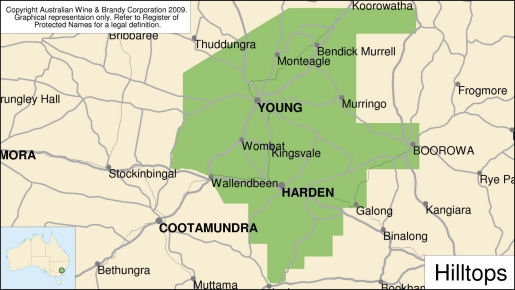
Hilltops Wine Region
Climate
While the climate is unequivocally Continental, with substantial diurnal temperature variation during the growing season, the altitude at which most of the vineyards are established ensures an even and lengthy ripening period. Spring frosts necessitate careful site selection along ridge tops and the upper, well aired and drained slopes. While substantial rainfall occurs in the growing season, most rain is in spring.
Soil
The dry summer and autumn provide excellent ripening conditions but make irrigation essential. The soils are rich and deep; typically dark red granite clays impregnated with basalt. While capable of holding water at depth, they are free draining and support strong vine growth. These soils persist along the ridge tops and hillsides, which provide the greatest degree of protection against frost.
Wines
Chardonnay: For such a warm area, the Chardonnays are surprisingly lean and elegant, with citrus and melon flavours merging into stonier and more mineral characteristics. They lend themselves to subtle oak handling and give every impression they will age with grace for five years.
Semillon: Several memorable late harvest Semillons have been produced in the region, but these days the accent is on dry table styles. They are powerful and carry excellent mid-palate weight, although they are not especially long on the palate; perhaps this will come with greater vine maturity. If it does, then wines of the highest quality will follow.
Cabernet Sauvignon: Like the Shiraz, the Cabernet Sauvignon is a powerful wine, yet neither aggressive nor heavy. The flavours are predominantly those of cassis, balanced by earthier chocolatey undertones. The tannins are quite strong and long-lived wines seem assured.
Shiraz: Shiraz is arguably the variety best suited to the region. The aromas and flavours are complex, moderately spicy and hold a range of chocolate, mint, black cherry and more briary characteristics. Acidity is good, and the tannins are supple.
Vital Statistics
| Map coordinates | 34° 19’S |
|---|---|
| Altitude | 450 m (1476 feet) |
| Heat degree days | 1880 (cut off at 19ºC (66.2ºF) but otherwise not adjusted) |
| Growing season rainfall, Oct-Apr | 310 mm (12.2 inches) |
| Mean January temperature | 22.5 °C (72.5°F) |
| Relative humidity, Oct-Apr, 3 pm | Average 38% |
| Harvest | Late Mar – May |