Riverina


Overview
This region is known variously as the Riverina, Murrumbidgee Irrigation Area and Griffith. Viticulture can be traced from 1912 and the arrival of John James McWilliam, who participated in the Murrumbidgee Irrigation Scheme. Growing 55% of the varietal grapes in New South Wales and 15% of the total Australian grape production, the Riverina is a very important wine region. As a producer of specialist wine grapes, its wine style of international importance is Botrytised Semillon.
The Big Picture
The Riverina is the second largest wine producing region in Australia and the largest in New South Wales. It is a flat tract of land on the state's south-west plains and is centred on the city of Griffith, which lies at latitude 34°S and longitude 146°W and at an elevation of 136m.
The term Riverina was apparently invented by John Dunmore Lang in the 1850s to describe a type of country (the Riverina Plain) and later a secessionist boundary. The term quickly caught on and began to replace the official district labels of Murrumbidgee and Lachlan.
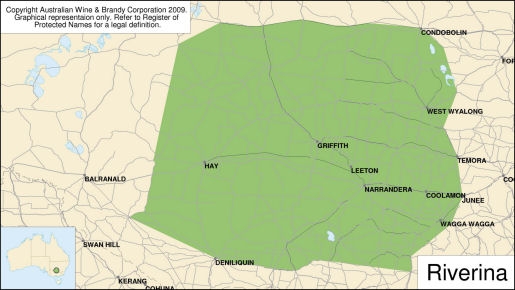
Riverina Wine Region
Climate
The region has an average annual rainfall of 406mm, which is spread evenly throughout the year. High evaporation and low relative humidity, high solar radiation and ample sunshine are features of the summer . A characteristic of the climate is high growing-season temperatures, with a mean for January of 23.8°C.
Autumn conditions favour the onset and spread of the fungus Botrytis cinerea, with the April to May temperature of 14.3oC and humidity of 77%. The warm climate decreases gradually with the onset of Autumn but still achieves a reasonably high daytime temperature. With showers usually accompanying this change of season, misty mornings and fogs arise, and this governs the degree of the Botrytis cinerea infection. The higher humidity late in the season allows Botrytis or “Noble Rot” development to occur after the picking of most of the red and white varieties. With the region having such a low natural rainfall, grapes can only be grown here economically with irrigation.
Soil
The Riverine plains were deposited by the action of ancient streams upon the remnants of the Great Dividing Range and thus consist of highly variable alluvial soils with sands and gravels embedded in clays.
The main soil type of the Riverina is red-brown earth. It has a loamy surface horizon 10-35 cm deep and passes abruptly to a reddish-brown clay which contains lime at a depth of about 70cm. Most of these red-brown earths are found around the lower hill slopes and river ridges. Many of these contain limestone rubble. It is on these soils that the majority of the vines are planted. More recent developments are on what was rice country in grey river soils.
Wines
Chardonnay: Chardonnay is the Riverina's third most important grape variety. A judicious use of oak produces a wine of pleasant varietal flavour, weight and style.
Semillon: Picked at normal maturity, Semillon provides a pleasant wine (which may be blended with other varieties) and is used in the making of generic styles. These days, in the almost certain expectation that they will be attacked by Botrytis cinerea, and if the weather conditions are favourable (they usually are), specially selected blocks of Semillon grapes are left on the vine for up to two months after maturity. As a consequence, Botrytis cinerea attacks the grapes, evaporating the water content of their juice and concentrating both its sugar and acid. The resultant wine is a luscious Sauternes-style dessert wine, which is the district's outstanding speciality.
Red Wines: Much good Shiraz and Cabernet Sauvignon is produced in the region. With the growing importance of exports, considerable research is being done on irrigation, nutrition and canopy management to improve fruit quality. As in Sunraysia, the quality of wine from this region improved significantly over the last decade of the 20th century.
Vital Statistics
| Map Coordinates | 34° 00'S |
|---|---|
| Altitude | 140 m (459 feet) |
| Heat degree days, Oct-Apr | 2201 (cut off at 19ºC (66.2ºF) but otherwise not adjusted) |
| Growing season rainfall, Oct-Apr | 200 mm (7.9 inches) |
| Mean January temperature | 23.8°C (74.8°F) |
| Relative humidity, Oct-Apr, 3 pm | Average 36% |
| Harvest | Early Feb - Early May |