Tumbarumba


Overview
The Tumbarumba region is unequivocally in the Snowy Mountains, a part of the Australian Alps which feature the nation's highest peak, Mount Kosciusko. Vineyards are found at altitudes ranging from 300 to 800 metres (984 to 2624 feet).
The Big Picture
Vines were established by Ian Cowell at Tumbarumba in 1982 and a year later by Frank Minutello at Tooma in the Maragle Valley, 18 kilometres (11 miles) to the south-east. Pinot Noir and Chardonnay account for 75% of plantings in the region (a testament to the cool climate), with the majority used for sparkling wine. The pace of development was slow up until 1992, but today there are more than 25 vineyards covering almost 300 hectares (741 acres).
The ability of the region to produce table wine, as opposed to sparkling wine, is dependent upon two things: seasonal conditions and site altitude. The margin for error is low and the need for first-class viticultural management is high. But when all goes well, the region can produce excellent table wine, even though its main business will be firmly linked to the production of high-quality sparkling wine.
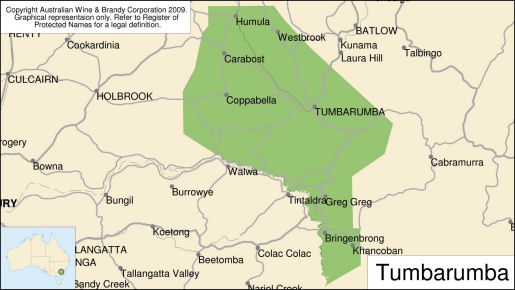
Tumbarumba Wine Region
Climate
Tumbarumba's climate is cool but no more so than that of the Yarra Valley. It is warmer, for example, than the Macedon Ranges in central Victoria or Henty in south-western Victoria. Moreover, there are a number of other, mutually counterbalancing factors; high sunshine hours with brilliant light, cold summer nights and a late start to the growing season. Frost is an ever-present viticultural threat and its presence dictates the necessity for careful site selection and management. Night temperature inversion can be tricky, but elevation is a counterbalancing and significant factor in determining varietal choice. The early autumn seasonal break can also pose problems.
Soil
These are typical high mountain soils, derived from decomposed granite and basalt, with a typically gritty and granular texture. The choice of viticultural site is chiefly determined by aspect (north and northeast-facing preferred, south-facing nigh on impossible) and slope (sufficiently steep to promote good air drainage at night and thus minimise the risk of frost).
Wines
Chardonnay: The sporadic releases of Chardonnay to date have been distinguished by crisp melon, citrus and fig fruit in the classic style of a cool climate wine.
Sparkling Wines: The essence of Champagne lies in the blending of 50 or more different base wine components drawn from areas scattered across the length and breadth of that classic French region. The best of Australian sparkling wines use the same approach, employing a classic blend of Chardonnay, Pinot Noir and Pinot Meunier but also utilising a multiplicity of other regional sources.
Pinot Noir: In 1994 Seppelt produced a Pinot Noir made from a blend of Tumbarumba and Drumborg grapes that deservedly won the Pinot Noir Trophy at the National Wine Show. There is no doubt the region has the capacity to produce very stylish Pinot Noir with a clear varietal character. Much more should be heard of Tumbarumba Pinot Noir in the future.
Vital Statistics
| Tumbarumba | |
|---|---|
| Map Coordinates | 34° 36'S |
| Altitude | 300-800 m (984-2625 feet) |
| Heat degree days, Oct-Apr | 1010 (cut off at 19ºC (66.2º F) but otherwise not adjusted) |
| Growing season rainfall, Oct-Apr | 375 mm (14.7 inches) |
| Mean January temperature | 19.3°C (66.7°F) |
| Relative humidity, Oct-Apr, 3 pm | Average 43% |
| Harvest | Early Mar – Early May |