Canberra District


Overview
The Canberra District wine region incorporates the majority of vineyard developments in the northern part of the Australian Capital Territory and the adjoining area of New South Wales.
The Big Picture
The vineyards of the Canberra District fall naturally into two groups. In the first are those near the border with New South Wales and the Australian Capital Territory, north-west of the city along the Barton Highway from Hall as far as Murrumbateman.
The second group is to the north-east along the Bungendore ridge and the north-west shore of Lake George, accessible from the Federal Highway, where the pioneer of the region, Dr Edgar Riek, planted the first vines in 1971.
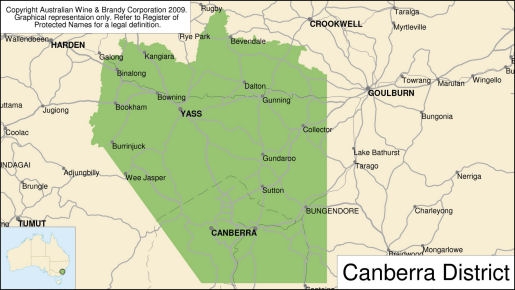
Canberra District Wine Region
Climate
With the constant threat and frequent occurrence of spring frosts, recurring droughts in spring and summer, a high diurnal temperature range (cold nights and hot summer days), and a generally cool harvest season, the region has one of the most strongly Continental climates in Australia.
It is a climate of extremes and one where supplementary irrigation is highly desirable if any semblance of yield consistency is to be maintained. Nevertheless, it is here that Riesling, Chardonnay, Shiraz, Cabernet Sauvignon and quite often Pinot Noir all produce wines of considerable personality.
Some of the region’s vineyards are planted on near-alpine slopes and cool autumn temperatures contribute to typical cool-climate wines, tending to the austere and elegant. Lower down the slopes, spilling into New South Wales, winemakers create fine, full-flavoured Chardonnay and Shiraz.
Soil
The topography of the region is quite varied, with undulating hills and distant views of the Snowy Mountains forming a picturesque backdrop to many of the vineyards. Slope, aspect and air drainage are all important. Soils in the district are typically brownish, shallow clay loams, often overlying shale or clay with a pH ranging from neutral to mildly acidic. The sub-soils are not particularly water-retentive and thus increase the need for irrigation.
With one exception, all of the wineries in the district are small; most were founded by academics and civil servants of scientific persuasion. All rely on local and tourist cellar-door trade, to which they cater very well. However, the opening of Hardy’s Kamberra winery and tourist complex on the main Sydney-Canberra road north of the city brought about a major change in perceptions, prompting a projection by Access Economics that wine will have become the most important rural industry in the region.
Wines
Chardonnay: The ubiquitous Chardonnay is an integral product range component for the majority of wineries. Some notably elegant wines are produced, with a good structure and complexity that reflects its cooler aspects.
Riesling: For some of the wineries, Riesling vies with Chardonnay as the most important white wine, showing similar personality and characteristics. The majority are made in a crisp, gently toasty, dry style, with sweeter styles less favoured than previously. Botrytis is not a significant factor. However, in the warmer years, more tropical characteristics appear. Modest yields ensure that the wines age well in bottle for up to a decade.
Sauvignon Blanc/Semillon: Attractive, moderately herbaceous wines are made from these varieties. They are frequently blended, but sometimes Sauvignon Blanc appears alone. The wines have good structure and the cooler vintages generate the best flavours.
Cabernet Sauvignon: As with all the wines of the region, varied climatic conditions from one vintage to the next and differing approaches in the winery make generalisations about style more than usually hazardous. Sometimes made as a single varietal wine but increasingly blended with Merlot, Cabernet’s overall weight and extract varies from light, leafy and minty to rich, concentrated and chocolatey.
Shiraz: This is a variety which is starting to come into its own as part of the general resurgence of interest, with several wineries producing spectacularly good examples that are redolent of spice, black cherry and liquorice. It would not surprise to see plantings of the Shiraz increase significantly in future years.
Vital Statistics
| Canberra | |
|---|---|
| Map coordinates | 35° 0’S, |
| Altitude | 500 - 850 m (1640 - 2788 feet) |
| Heat degree days, Oct-Apr | 1410 (cut off at 19ºC (66.2ºF), otherwise not adjusted) |
| Growing season rainfall, Oct-Apr | 360 mm (14.1 inches) |
| Mean January temperature | 20.2º C (68.3ºF) |
| Relative humidity, Oct-Apr, 3 pm | Average 41.5% |
| Harvest | Mid Mar - End Apr |