New England Australia, NSW


Overview
The New England Australia region of NSW is dominated by an upland plateau with cold winters and cool to warm summers that allow the production of both red and white wines. It is a region with a diversity of soils and aspects, and a network of small towns and villages with a long tradition of horticultural innovation and experiment.
A comparison with the famous Burgundy region in central France is not so far fetched, especially in the diversity of potential terroir, that happy combination of climate, terrain and people. With the vineyards growing in a lush chequerboard landscape of other specialist crops, including Australia’s largest gourmet snail farm on the nearby Liverpool Plains, the valleys may well be re-christened the Cote du Peel and the Cote du Gwydir in playful tribute to their Gallic template.
The Big Picture
Wine growing in New England began early in the 19th century and by the 1880s the district was winning international prizes for its wines. In 1882 it was described as "one of the foremost wine producing regions in the colonies" in the Sydney Daily Mail. Abandoned vines from this era still twine around old homestead ruins on the alluvial plains of the Peel and Upper Gwydir river valleys.
Australia’s highest vineyard lies at 1320 metres above sea level at Black Mountain, via Guyra, near the crest of the tableland. Winter frost and snow are regular features at this altitude. At around 1000 metres above sea level, the Armidale and Tenterfield areas produce cooler climate wines while the Peel and Gwydir valleys produce warmer climate wines. There are five wineries, 42 vineyards, 19 cellar doors and 291 hectares of vines in the region.
Armidale is also home to Australia’s oldest regional university, CSIRO and NPWS research centres, and more than 20 cattle and sheep breed societies. This creates a critical mass of agriculturally-focused research centres, including the White Wine Co-operative Research Centre at the University of New England (UNE), ensuring that the local wine industry benefits from world-leading wine and horticultural research.
The local wine industry sits well with the other specialist niche food markets flourishing in the district, such as gourmet cheese, value-added meat products, trout, olives, pasta, berries, pome fruit and fruit wines.
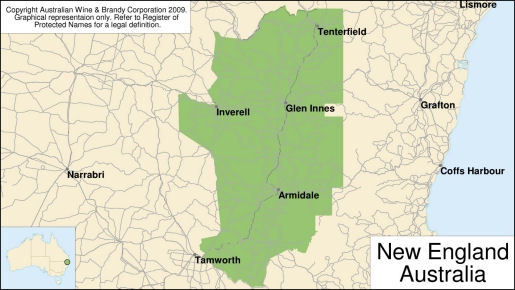
New England Australia Wine Region
Climate
Most of New England’s rain falls between late summer and early autumn. Summer days are warm, rarely exceeding 30º C, followed almost always by cool nights. Thunderstorms often produce heavy falls of rain and occasionally destructive hail. Severe frosts set in from June. Late frosts and even snow are possible until November, presenting major problems for vine growers, and UNE researchers in cooperation with growers have developed some innovative systems to guard against this.
Soil
Rich alluvial soils are deposited by the Peel River in valley flats around Tamworth. From here the elevation rises sharply up through the Moonbi Hills on the way north to Armidale. This is granite country and the soils are rough and highly suited to wine grape production. Around Inverell the soils are black earth. Along the spine of the Great Divide from Uralla to Glen Innes the hilltops are basalt, while downslope are the lighter "trap" soils. In the far north around Tenterfield the country is granite again, with extensive sandy loams.
This is the only place in Australia where the famous terra rossa soils, Australia's most prized soil for viticulture, exist at high altitude and are thus subject to a cool climate suitable for white wine production.
Wines
Chardonnay: The New England region offers some very elegant and well balanced Chardonnays with excellent varietal definition. These wines display generous aromas of stone fruit, citrus and tropical fruit. The careful use of oak allows beautiful integration with the fruit, ensuring some delightful easy-drinking wines.
Riesling: Fragrant floral characters, exotic and citrus fruit round out the aromatics of these lively wines. The rich fruit flavours and balanced acidity ensure these Rieslings linger wonderfully on the palate.
Sauvignon Blanc: The region’s Sauvignon Blancs are enhanced with aromas of gooseberry, lemon and passionfruit characteristics. These elegantly structured wines offer a mouth-filling harmony of fruit and acid.
Shiraz: The delicate aromas of plum, red berries and white pepper are frequently found in the Shiraz from the region. Soft, velvety tannin structures enhance the mouth-feel and roundness on the palate. The careful use of oak contributes to the great structure and length of these wines.
Vital Statistics
| Map coordinates | 30º 3'S |
|---|---|
| Altitude | 365 - 1320 m (1197 - 4329 feet) |
| Heat degree days, Oct-Apr | 1413 - 2126 (cut off at 19ºC (66.2ºF) but otherwise not adjusted) |
| Growing season rainfall, Oct-Apr | 545 mm (21.4 inches) |
| Relative humidity, Sep-Mar, 3 pm | 46% |
| Mean January temperature | 21°C (70°F) |
| Harvest | March - June |