South Burnett


Overview
While the modern history of the South Burnett region dates back only as far as 1993, vines were first planted in the early 1900s and wine for home consumption was made from some of these vines. As in the Granite Belt, table grapes were used both for winemaking and for eating in the early days.
In 1994, a report commissioned in conjunction with the Queensland Government to assess the agricultural and winery potential of the region (The Macarthur Report) revealed very similar viticultural and climatic conditions to those of the Hunter Valley in New South Wales, making the South Burnett ideal for wine production.
The Big Picture
The town of Kingaroy is the geographical centre of the South Burnett region, which is defined by Blackbutt and the Brisbane and Coast Ranges in the east, the Great Divide to the south-west and west, and the Central Burnett and Burnett River to the north. The Stuart and Booie Ranges run from south to north through the centre of the region, with the gentle, undulating countryside of the Stuart and Boyne River plain in the west and Barkers Creek in the east.
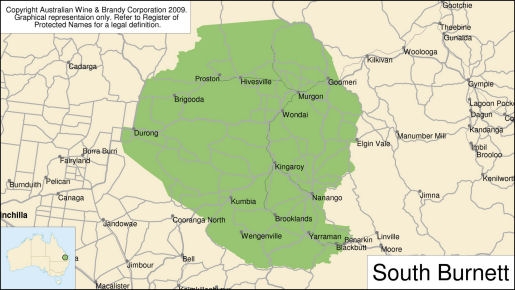
South Burnett Wine Region
Climate
The climate can be classed as sub-tropical. November through to March is warm, with and the heaviest rainfall during December, January and February.
Soil
There is a diverse range of soils, described in ascending order as light sands, a variety of light clay red soils through to brown and black clays. The red, brown and black soils are of moderate to high fertility, and all have a pH level suited to viticulture.
Wines
Verdelho: South Burnett Verdelho has been well received. This variety appears to be well suited to warmer days and cool night. Wines are often aromatic, with herbaceous and tropical fruit flavours. Queensland is rapidly gaining a reputation for producing the best Verdelhos in Australia.
Chardonnay: As one might expect, this ever-flexible and accommodating variety performs well in the region. The wine tends to be soft but has pleasant and clear varietal character in a nectarine and melon spectrum. The use of quality oak and modern winemaking practices has produced many wines with good complexity and structure, but the unwooded Chardonnay also works quite well.
Semillon: The style of the Semillon is better compared to that of the Upper Hunter than the Lower Hunter. In other words, it mirrors some of the softness of the region’s Chardonnay and is relatively quick to develop. However, it does provide a distinctive varietal flavour, with some citrus and herb, and it is not surprising to find it in second place in the white wine plantings.
Cabernet Sauvignon and Merlot: This region is producing medium bodied wines with soft, sweet berry flavours. As the vines age, more extract and structure can be expected when vintage conditions are favourable.
Shiraz: The warm climate produces wines which are smooth and supple, light to medium bodied and with soft tannins. There are none of the spice and pepper notes sometimes evident in the Shiraz of the Granite Belt. Instead, ripe cherry, plum, mint and chocolate flavours are present in varying degrees.
Vital Statistics
| Map Coordinates | 26° 00' S |
|---|---|
| Altitude | 300 – 600 m (984-1968 feet) |
| Heat degree days, Oct-Apr | 2500 (cut off at 19ºC (66.2ºF) but otherwise not adjusted) |
| Growing season rainfall, Oct-Apr | 490 mm (19.3 inches) |
| Mean January temperature | 23.8°C (74.8 °F) |
| Relative humidity, Oct-Apr, 3 pm | Average 51% |
| Harvest | End Jan – Early Mar |