Granite Belt


Overview
Thanks to its strong Italian community, the Granite Belt has had a long history of viticulture and winemaking with table grapes. Since the first Shiraz vines were planted in 1965 the region has grown fitfully, but dramatic growth is envisaged, with emphasis now being placed on Chardonnay, Verdelho, Shiraz, Merlot and Cabernet Sauvignon.
The Big Picture
The wineries of the Granite Belt are small to medium in size and owned and managed by families and individuals with a passion to make great Queensland wine. The region's vineyards have incorporated modern trellising, trickle irrigation and protection methods and are important sources of grapes for major winemaking projects outside the district.
The Granite Belt is one of the highest grape growing regions in Australia, with vineyards planted at over 1000 metres above sea level.
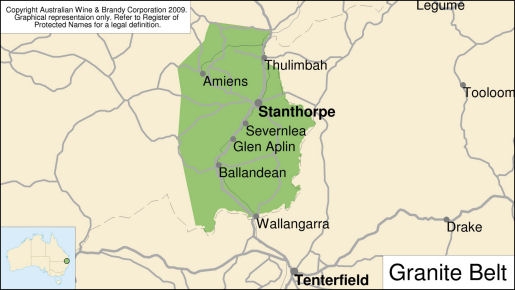
Granite Belt Wine Region
Climate
Notwithstanding the extreme northerly latitude, its situation on the inner or eastern spine of the Great Dividing Range at an altitude of more than 800 metres (2625 feet) makes this a table wine region. Spring frosts, cold nights at the beginning and end of the season, relatively high humidity, peak summer temperatures moderated by sub-tropical monsoon influences and intermittent heavy late season rainfall all contribute to a climate that could be regarded as unusual; a climate which has been described as both cold and warm.
It is in fact a lot cooler than most expect, as confirmed by its late harvest dates. Cool winter and spring weather make the Granite Belt an ideal viticultural area and an attractive tourist destination.
Soil
The Granite Belt, a massive granite intrusion approximately 200 million years old, is the northern most extension of the New England Tableland, a stepped plateau of hills and plains with elevations of between 600 and 1500 metres (1,968 to 4,921 feet) on Permian sedimentary rocks, intrusive granites and extensive Tertiary basalts. Rainfall, temperature and soils change with topography and bedrock. The vegetation is extremely diverse, with a high degree of endemism as instanced by the more than 70 species of Eucalyptus, one third of which are endemic or near endemic to the bioregion. The most spectacular scenery is at the southern end of the region, where streams have dissected the granite to produce dramatic boulder-strewn landscapes.
The two principal soil types are a highly permeable, granite speckled sandy, grey-black soil and a light brownish grey, also speckled. Such soils are quite different to those encountered in most Australian wine regions. The subsoils are bleached sand passing into clay at depth; while their drainage is good, the need for irrigation is increased.
Wines
Verdelho: Queensland is rapidly gaining a reputation for producing the best Verdelhos in Australia. This variety appears to be well suited to warmer days and cool night. Wines are often aromatic, with herbaceous and tropical fruit flavours.
Chardonnay: This variety performs very well in the region. The wine tends to be soft but has pleasant and clear varietal character in a nectarine and melon spectrum. The best wooded wines are usually well structured and have great length. Most producers also produce unwooded Chardonnay.
Viognier: Plantings of Viognier have increased rapidly over the past five years. White wines are often dry, with a fruity, citrus palate. Small quantities of Viognier may be added to Shiraz to give lightness, delicacy and perfume to the red wine.
Cabernet Sauvignon: Like Shiraz, this wine is full, dark and rich in flavour – at times perhaps rather too much so. Cassis, red berry and sweet fruit flavours predominate, attesting to the warm climate and the often vanillin oak.
Shiraz: This is the one consistently distinctive wine style of the region; dark in colour, strong in body, flavour and tannins. Above all else, is its redolent of spice when young, developing into a soft, sweet velvety fruit with time in bottle, reminiscent of the Shiraz from the Hunter Valley.
Vital Statistics
| Map Coordinates | 28° 40' S |
|---|---|
| Altitude | 810 m (2657 feet) |
| Heat degree days, Oct-Apr | 1602 (cut off at 19ºC (66.2ºF) but otherwise not adjusted) |
| Growing season rainfall, Oct-Apr | 519 mm (20.4 inches) |
| Mean January temperature | 20.6°C (69°F) |
| Relative humidity, Oct-Apr, 3 pm | Average 53% |
| Harvest | End Feb - Mid Apr |