Murray Darling


Overview
Straddling the Murray River in north-west Victoria and western New South Wales, though principally on the Victorian side of the border, the Murray Darling is a vast region. Plantings are primarily concentrated around Mildura, Red Cliffs, Robinvale, Euston and Merbein.
The Big Picture
The Murray Darling is the second largest wine region in Australia, with about 1,300 growers and 23,000 hectares of vineyards producing more than 400,000 tonnes annually (up to 25% of the national crush, depending on seasonal variations). The value of winegrape production is about $200 million a year. More Chardonnay (in excess of 100,000 tonnes annually) is produced in the Mildura Murray Darling region than anywhere else in Australia. The Murray Darling also produces more than 130,000 tonnes of Shiraz and Cabernet Sauvignon.
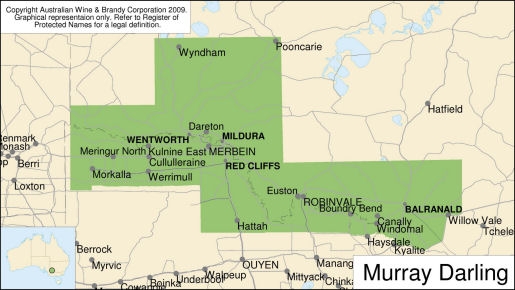
Murray Darling Wine Region
Climate
Although the distance between the eastern and western extremity is in excess of 350 kilometres (217 miles), the climate throughout is virtually identical. It is hot, with long sunshine hours, low humidity and negligible growing season rainfall, making irrigation essential. The Continental influence is strong, with consequent high shifts in diurnal temperature ranges, but insufficient to make spring frosts a problem. Fungal disease pressures are low, and other than for control of eutypa, spray requirements are minimal.
On a superficial assessment, the terrain seems flat and hence irrelevant to growing conditions, but subtle differences in height can be very important in affecting drainage. The scenery is also broken in parts by gentle dune and swale formations, but there is no escaping the fact this is big-production vineyard region.
Soil
The soil is unique to the Murray River system and is known technically as calcareous earth, ranging from brown to red-brown loamy sand, sandy loam or loam. The surface is neutral to moderately alkaline with increasing alkalinity at depth as textures become more clayey and calcareous. The surface soils are permeable, although perched water tables (attributable in part to soil properties and topography resulting from management practices associated with salinity build-up) can create problems in some areas. Overall, however, the soil supports the vigorous growth and high grape yields required.
Wines
Chardonnay: By far the most important premium product of the region, Chardonnay is likely to find its way into bottles that acknowledge both the regional source and the variety. The wines have a fruity softness and generosity, which is highly prized where value for money is the key.
Shiraz and Cabernet Sauvignon: The red wine boom has seen the plantings of these varieties increase dramatically and encouraged the production of bottled (as opposed to cask) red wine of excellent quality in the lower to mid-price range. These have good colour and plenty of soft, sweet fruit, making them ideal for drinking at one to two years of age.
Other Table Wines: Colombard is making an impact as a quality table wine. Although the Murray areas represent a major source of economically priced wines, several wineries are striking success in creating distinct wine styles through the combination of advanced vineyard management and considered oenological approaches to this typically hot climate fruit.
Fortified Wines: In an ever-shrinking market for such products, the Murray Darling riverlands produce value-for-money fortified wines.
Vital Statistics
| Map Coordinates | 34° 10'S |
|---|---|
| Altitude | 55 - 70 m (180 - 229 feet) |
| Heat degree days, Oct-Apr | 2150 - 2240 (cut off at 19ºC (66.2ºF) but otherwise not adjusted) |
| Growing season rainfall Oct - Apr | 130 - 150 mm (5.1 - 5.9 inches) |
| Mean January temperature | 23.7º C (74.6ºF) |
| Relative humidity, Oct-Apr, 3 pm | Average 30% |
| Harvest | Late Jan-Mid Mar |