Swan Hill


Overview
Swan Hill was discovered and named in 1836 by the Surveyor-General of New South Wales, Major Thomas Mitchell, who had camped by the River Murray and spent a noisy night disturbed by flocks of black swans. He observed, however, that the soil was rich and "capable of being easily irrigated by the river". His prophecy of irrigation ultimately came to pass, and by 1900 the production of Muscat and sultanas for dried fruit had commenced at Nyah. The region's first winery, St Andrews, was erected in 1930 by the Thomson family, and is still active . R.L. Buller & Son of Rutherglen also built a winery in 1951 at Beverford.
The Big Picture
With a lower temperature and higher rainfall than Sunraysia, Swan Hill is considered to be on the southern end of Victoria's hot climate region. It is serviced by three irrigation schemes; Tresco, Woorinen and Nyah cover areas of 1,400 hectares, 1,600 hectares and 1,100 hectares respectively.
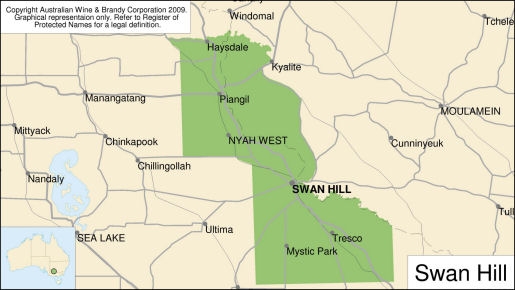
Swan Hill Wine Region
Climate
Swan Hill is an undeniably hot region, though marginally cooler than Murray Darling and with a slightly higher annual rainfall. Irrigation is, of course, essential.
The mean annual range of temperature of 14.3°C compares to Sunraysia's (Murray/ Darling) 13.7°C and gives, for Shiraz, a budburst date five days later, a flowering date 11 days later and a ripening period eight days later. Some varieties of wine grapes in the Swan Hill region have a delayed harvest of up to two weeks compared to Sunraysia.
Soil
Like the Murray Darling region to the north-west, this flat area straddles the Murray River and has red-brown loamy sands (calcareous earths), which range in pH from neutral to alkaline.
This is a relatively arid region with soil structures of limestone, marine sands and clays associated with the Miocene sea overlain by lacustrine (from a lake), fluviatile (from a river) and aeolian (wind borne) deposits, which have built up over cycles of stable and unstable periods of history. They are over 90 metres deep.
Wines
Chardonnay: This wine has a soft, melony, peachy easy-drinking style to be consumed generally within two years of vintage or soon afterwards.
Shiraz: These medium bodied fruity reds can usually be drunk within two years of making.
Cabernet Sauvignon: The region produces Cabernet of good colour, moderate berry nose and a medium-weight, berry-flavoured palate. Such wines are consumable over the medium term of two to three years.
Vital Statistics
| Map Coordinates | 35º 20´S |
|---|---|
| Altitude | 60-85 m (197-279 feet) |
| Heat degree days, Oct-Apr | 2138 (cut off at 19ºC (66.2ºF) but otherwise not adjusted) |
| Growing season rainfall Oct - Apr | 178 mm (7 inches) |
| Mean January temperature | 23.6º C (74ºF) |
| Relative humidity, Oct-Apr, 3 pm | Average 35% |
| Harvest | Feb-Mid Mar |