Rutherglen


Overview
Winemaking has been a family tradition in Rutherglen since the 1850s, and fourth, fifth and sixth generation winemakers are now producing outstanding and award winning wines. Crisp whites, rich reds and world famous fortifieds are produced with a unique regional character.
Rutherglen is the unchallenged capital of fortified wines in Australia, with muscats and tokays internationally recognised.
The Big Picture
Vines came to Rutherglen with the Gold Rush of the 1850s. Grand brick buildings and wineries such as Fairfield, Mount Prior, All Saints and Gehrig Estate speak of the prosperity of the late Victorian era and the glory days of the last third of the 19th century; but so, too, do the humble galvanised iron wineries of present icons such as Morris and Chambers’ Rosewood.
When the rest of Victoria went into a decline in the face of the move to fortified wine production, the north-east came into its own, notwithstanding the onslaught of phylloxera around the turn of the century.
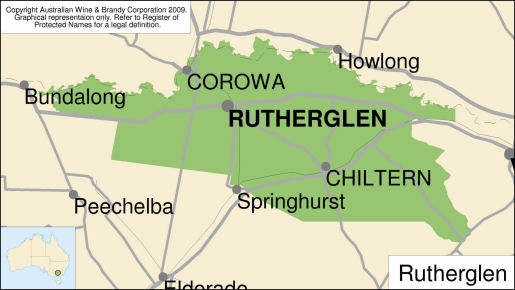
Rutherglen Wine Region
Climate
The climate is strongly Continental, with very hot summer days and cold nights. The growing season can be threatened at one end by spring frosts that are exacerbated by cold air blowing down from the mountains to the south and at the other end by the abrupt arrival of autumn rain. But when conditions are favourable, the exceptionally high sugar levels needed for fortified wines (and which power the full bodied red table wines) are attained.
Soil
The great fortified wines for which the region is famous are grown on a band of loam (locally called Rutherglen loam) on the lower slopes of the gentle local hills. This snakes its way around the centre and extends four kilometres (2.3 miles) to the east and five kilometres (3 miles) south of the town. It is shared by Morris, Chambers, Campbells and Stanton & Killeen, some of the leading producers of those wines. Another entirely different soil type is ‘"Black Dog fine sandy loam" found around wineries closer to the River Murray, including All Saints, Cofield and Pfeiffer.
Wines
Muscat: Wrought from the brown clone (or type) of Muscat à Petits Grains Rouge, more commonly known as Rutherglen Brown Muscat or Brown Frontignac, this is Rutherglen’s most famous fortified wine variety and conventionally regarded as its greatest. Virtually unique in the world (Cyprus, South Africa and Spain are, or have been, competitors), this distilled essence of liquid raisins achieves undreamed-of layers of complexity as it ages (and greatly oxidises) in cask. Once imprisoned in a bottle, such changes cease; its only future to be drunk. Explosively rich and sweet though the Muscats are, the finish is cleansing and brisk, if not dry in the technical sense. The finish does not cloy nor seem as sweet as the plum pudding flavours of the mid palate would suggest. A great winter aperitif and an after dinner wine at any time of year.
Fortified Aged White: This wine is unique, for nowhere else in the world is an aged, fortified wine produced as it is here from the Muscadelle grape, the very junior partner to Semillon and Sauvignon Blanc in making the sweet botrytised table wines of Sauternes. In this fortified white it has an intense varietal aroma and flavour that is akin to a mixture of cold tea and fish oil (in the best possible sense). Toffee and butterscotch are also commonly used descriptors for a wine which has more grace than the all-powerful Muscat, and is preferred by some winemakers and wine judges simply because it has that grace. Young fortified whites are a sheer delight, and can be enjoyed anywhere, any time. However much convention would anchor them at either the start or finish of a meal.
Shiraz: This is a Rutherglen red table wine of size and strength and traditionally made in heroic dimensions, befitting Dionysus, the Greek god of wine – or any other god for that matter. For a time, contemporary taste suggested that the weight of these wines should be downscaled, but this is no longer the case. Some of the fullest-bodied wines in Australia now come from this region.
Other Red Wines: Such well-known varieties as Cabernet Sauvignon compete with the regional specialties of Durif and Mondeuse, either as single varieties or occasionally blended with Shiraz. Deep colour, full flavour, high levels of natural alcohol and sometimes considerable tannin are the natural consequence of the combination of climate and soil in this region.
Vital Statistics
| Map Coordinates | 36° 10´ S |
|---|---|
| Altitude | 170 m (557 feet) |
| Heat degree days, Oct-Apr | 1770 (cut off at 19ºC (66.2ºF) but otherwise not adjusted) |
| Growing season rainfall Oct-Apr | 297 mm (11.7inches) |
| Mean January temperature | 22.3°C (72°F) |
| Relative humidity, Oct-Apr, 3 pm | Average 38% |
| Harvest | End Feb-Early May |