Beechworth


Overview
The discovery of gold in March 1852 provided the impetus for the development of Beechworth. The town, proclaimed the following year, was built on the fortunes made from that precious metal. Perched precariously on a steep hillside, with streets plunging at precipitous and unexpected angles, its stone buildings and glorious vistas of imported English trees are a wondrous sight to behold in autumn. The earliest land sales took place in 1855, with the first vines planted in 1856 by a Mr Rochlitz, who had obtained varieties from Adelaide.
The Big Picture
The mineral rich hills around Beechworth are home to more than a dozen vineyards. These vineyards are tended by winegrowing families with a fierce independence and a passion for making the best artisanal wines. Local wineries produce grape varieties ranging from classic French (particularly Chardonnay, Pinot Noir, Sauvignon Blanc and Shiraz) to savoury Italian. Beechworth's grape growing industry is quickly expanding.
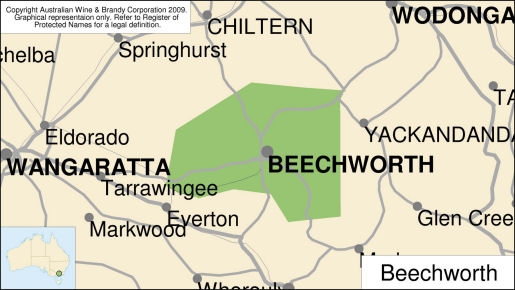
Beechworth Wine Region
Climate
Typically, the climate is linked to altitude, with a wide range in heat degree summations between the lower and higher elevations. Rainfall increases with altitude, while humidity decreases. Frost risk is site specific, as most of the vineyards are planted on slopes with free air drainage taking the frost downhill to pond in the valleys below. In addition to unsuitable soils for dam construction, the lack of underground water places severe limitations on irrigation and is considered a major barrier to large-scale viticultural development. Individual developments are likely to be no more than 10 hectares (25 acres), with a maximum of 20 hectares (49 acres).
Soil
There are two major soil types in the region – the very old Ordovician sandstone, mudstone and shale derived from marine sediments and the Devonian granites with their more intrusive, igneous nature.
Wines
Chardonnay: Chardonnay is grown at most elevations by the majority of grape growers and winemakers throughout the region. Some well-known brands create a supremely elegant, restrained and complex style of wine, which also has the potential to cellar well. At the highest elevations, the grapes will most likely be used for sparkling wine, while richer table wines will come from the lowest elevations.
Pinot Noir: The variety has the greatest chance of success at elevations such as Beechworth and above, i.e. 550 metres (1,804 feet) and higher. The climate at lower levels is too warm for the variety to express itself typically.
Shiraz: This grape has already made its mark with the rich but elegant styles. It seems certain to provide stylish wines at intermediate altitudes, with more traditional varieties at lower levels.
Vital Statistics
| Map Coordinates | 36° 21'S |
|---|---|
| Altitude | 300 - 720 m (984 - 2361 feet) |
| Heat degree days, Oct-Apr | 1240 - 1687 (cut off at 19ºC (66.2ºF) but otherwise not adjusted) |
| Growing season rainfall Oct - Apr | 370 - 550 mm (14.5 - 21.6 inches) |
| Mean January temperature | 19.9 - 20.4º C (68 - 68.7º F) |
| Relative humidity, Oct-Apr, 3 pm | Average 42% |
| Harvest | Mid March - end April |