King Valley


Overview
Encompassing the watershed of the King River, this is an increasingly important grape growing region, albeit one of extremely varied terrain. King Valley supplies grapes to an extraordinary number of leading wineries across South Australia, Victoria and New South Wales, a factor that has not helped in establishing its identity to the Australian public at large.
The Big Picture
The King River joins the Ovens River at Wangaratta and the King Valley region runs south through the Oxley Plains for 25 kilometres (16 miles) to Moyhu before entering a number of narrow valleys with steep, well-timbered hillsides in the foothills of the Alps. At its northern end is Milawa, which is at the lowest point of 155 metres (509 feet). At the southern end is the Whitlands plateau, at 800 metres (2624 feet) one of the highest wine grape growing areas in Australia. It is fertile country capable of producing high yields of good quality grapes across the full spectrum from Chardonnay to Cabernet Sauvignon.
The region ranges from basically flat in the north to mountainous in the extreme south. Owing to the abundance of suitable land, most of the vineyards have been established on relatively gentle slopes, typically north and north-east facing.
In recent years considerable experimental development has been undertaken on a wide range of varieties, including the Italian grapes Barbera, Dolcetto, Nebbiolo and Sangiovese, and other rarities such as Tannat, Saperavi, Petit Manseng, Pinot Grigio and Tempranillo.
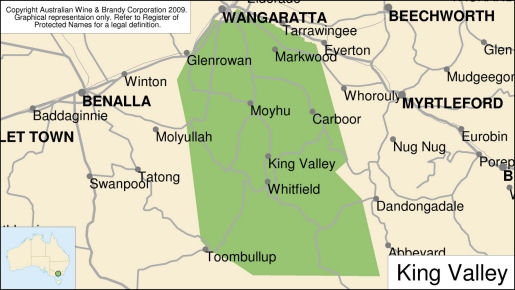
King Valley Wine Region
Climate
The climate changes progressively and significantly from lower northern to higher southern elevations, with a progressive increase in rainfall and a decrease in heat summations. Thus, at Milawa the growing season rainfall is 329 mm (13 inches) but at Myrrhee and Whitfield, halfway up the valley at an elevation of 320 metres (1050 feet), it has risen to 442 mm (17 inches) while at Whitlands it is 630 mm (25 inches). Ripening is progressively delayed; the style of wine changes, and at the highest altitude only the earlier ripening white varieties are suited to table wines. However, the climate is ideal for the production of fine sparkling wine base.
Soil
As one would expect, the soil types vary significantly throughout the valley, changing with altitude, slope and site characteristics. However, deep red clay loams abound, at times veering more to grey or brown in colour but having the same structure. Drainage is good, fertility high, and vigorous growth is encountered in virtually all sites.
Wines
Chardonnay: Chardonnay has now overtaken Riesling as the major white grape of the region, producing both table and sparkling wine. By far the greatest amount of Chardonnay is produced by Brown Brothers, followed by Miranda. The wine is soft and rich, with yellow peach, fig and tropical fruit flavours, and tends to be relatively quick developing.
Riesling: This is made principally as a dry style but some late harvest wines are produced.
Cabernet Sauvignon: This is the most widely planted variety in the King Valley and, as one would expect, has its strongest foothold at low to intermediate elevations. Ripening readily, the Cabernet Sauvignon produces the typically large yields of the region. The resultant wines are soft but flavoursome, making excellent blend components for commercial wines designed for early consumption. The flavours are in the sweet berry spectrum, with just a hint of mint and more herbaceous notes.
Sparkling Wines: Chardonnay and Pinot Noir are principally utilised by many of Australia's leading sparkling winemakers as blend components. Brown Brothers vintage and non-vintage sparkling wines are entirely drawn from King Valley fruit, and have enjoyed substantial success at national wine shows in recent years.
Vital Statistics
| Wangaratta | |
|---|---|
| Map Coordinates | 36º 20´S |
| Altitude | 155 - 860 m (508 - 2821 feet) |
| Heat degree days, Oct-Apr | 1350 - 1580 (cut off at 19ºC (66.2ºF) but otherwise not adjusted) |
| Growing season rainfall, Oct-Apr | 640 - 1410 mm (25.1 - 55.5 inches) |
| Mean January temperature | 20.8 - 22.0º C (69 - 72º F) |
| Relative humidity, Oct-Apr, 3 pm | Average 36% |
| Harvest | Early Mar-Late Apr |