Glenrowan


Overview
Glenrowan is one of Victoria's most historic wine regions, with production dating back to 1870. This picturesque small region comprises 13 growers and seven cellar doors. Though phylloxera devastated the region in the late 1890s and early 1900s, most successful vineyards were quickly replanted with disease-resistant rootstock, and winemaking resumed.
The Big Picture
Renowned throughout Australia as "Kelly country'", few know that the wine history of Glenrowan preceded the infamous bushranger Ned. After settlement in the 1840s and 1850s by the Rowan family of graziers, after whom the town is named, Richard Bailey and his family established themselves in the early 1860s on their Bundarra property, situated north-west of the town. The Baileys had followed the gold prospectors of the 1850s and settled in the area as storekeepers, supplying the diggers on the Beechworth and Ovens goldfields. After gold fever abated , Richard sold the store and purchased Bundarra, where he ran cattle and sheep for a time.
In 1866, Richard's son Varley planted vines on the rich red granite soil beneath the Warby Ranges. The vines thrived, as did the orchards planted soon after. His fortified wines were such a success that he quickly expanded the vineyard and in the next 20 years created a thriving local and export wine business. Bailey's Bundarra winery was carried on by his descendants until 1972. Esca Booth also came to the region in 1904 and his descendants still make wine at Taminick Vineyards.
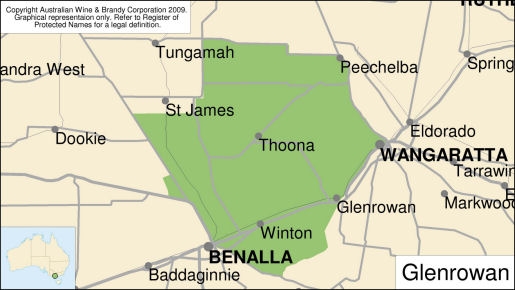
Glenrowan Wine Region
Climate
The climate is ideal. Glenrowan is undoubtedly warm – and comparable to nearby Rutherglen, with which it shares a robust style of red and rich fortified wine. It is slightly cooler in January, drier during the growing season and wetter year round, yet has a considerably higher heat degree day summation (1567). The region has low rainfall probability during the ripening period, with cool night temperatures. The constant breeze allows the vines to cool rapidly at night and warm early in the morning, which maximises the daily ideal temperature duration for colour, flavour and tannin development. The consistency of seasons is a real feature, delivering limited vintage variability.
Soil
The Warby Ranges, which formed over millions of years via marine deposits and several faults which lifted up part of the granite, are the predominant geological formation in the region. The vineyards on their slopes are established on the well-drained, fertile, deep red clay and loamy clay soils that result from the weathering of granitic material washed down from the ranges. On the ranges themselves, at 400 metres (1,312 feet) elevation, there are also red and yellow duplex soils especially suited to vineyards and orchards. The soil types surrounding nearby Lake Mokoan are dark clays, loams and silty sands.
Wines
Shiraz: There are many stories about the massive palate weight of earlier Baileys Bundarra Shiraz (formerly and famously called Hermitage). The most famous quote was that it was at once “wine, food and a good cigar”. The earthy berry-flavoured Shiraz reds of Glenrowan have been trimmed down somewhat in recent years, but they remain wines of stature and among the bigger Australian Shiraz styles, worthy of cellaring for many years.
Other: Old mellow fortified reds made from Shiraz and sometimes Touriga; quite sweet and with somewhat greater body than the tawny styles of South Australia. Older examples can show considerable rancio characteristics. Muscats and Tokays vie with those from the nearby Rutherglen region for primacy among Australia’s dessert wine styles. Some critics emphasise the finesse of the Rutherglen styles, while others prefer the sheer power of those at Glenrowan.
Vital Statistics
| Map Coordinates | 36º 27´S |
|---|---|
| Altitude | 190 m (623 feet) |
| Heat degree days, Oct-Apr | 1750 (cut off at 19ºC (66.2 ºF) but otherwise not adjusted) |
| Growing season rainfall, Oct-Apr | 310 mm (12.2 inches) |
| Mean January temperature | 22.2º C (72ºF) |
| Relative humidity, Oct-Apr, 3 pm | Average 36% |
| Harvest | End Mar-end Apr |