Upper Goulburn


Overview
The Upper Goulburn wine region is diverse in its geography. It spans north of the Yarra Valley, stretching from Glenburn to Mansfield-Mt Buller, along the Melba and Maroondah Highway, and from Tallarook and Yea to Eildon along the Goulburn River. The region is rich in natural beauty of lakes and river systems and is recognised as the major gateway to Victoria’s high country. This is truly cool climate viticulture, making the Upper Goulburn a distinctive region in Victoria.
The Big Picture
Winemaking began in the Upper Goulburn when the Ritchie planted grapes at their Delatite property in 1968. While a relatively large region, it is unified by its elevation and hilly topography. Much of the area is above 300 metres (984 feet), with peaks to 1800 metres (5905 feet). However, the majority of the vineyards are planted between 300 and 500 metres (984 and 1640 feet).
Overall, it is a premium to super-premium wine-producing area. Yields are significantly lower than those of the King Valley, for example, and the cool climate produces generally fine wines. Elevation is a key factor in determining style.
This region is prominent year round on the tourist map. Delatite is situated on one of the ski routes, while in summer the Lake Eildon area is popular for trout fishing and water skiing.
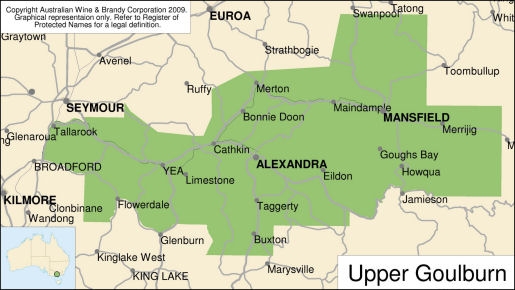
Upper Goulburn Wine Region
Climate
The climate is strongly influenced by altitude (300 -700m) but the picking dates, and the wine styles, leave little doubt that this is a very cool region overall. Rainfall varies from 700mm to 1400mm. Rainfall, as usual, increases with altitude and heat summation varies considerably. The much-photographed Delatite Vineyard with a full summer canopy of leaves and snow-clad mountains in the background illustrates the point, and most of the vineyards experience winter snows. As in all high country, site selection is of paramount importance. North and north-east facing slopes offer the best chance of fully ripening the grapes. Care must also be taken to ensure the slope does not end in a gully or valley, which will trap cold air and increase the likelihood of frost. The cool evenings of the high country, combined with its location on the northern side of the Great Dividing Range with significantly higher sunlight hours, gives the region a natural advantage. The Upper Goulburn has a commitment to quality production with a low environmental footprint leading to less intervention with chemical additives.
Soil
The soils are varied, although the region as a whole is geologically described as the physiographic region of the East Victorian Uplands and comprises dissected high plateaux established on various resistant rocks. These give rise to soils that range from granitic and granodiorite to sandstone, siltstone, claystone, limestone and dolomite.
Wines
The region is ideal for the production of crisp and racy aromatic white and sparkling wines and elegant, textural red wines. Riesling and Gewürztraminer wines produced in the area have received international recognition. Varieties such as Chardonnay, Sauvignon Blanc, Pinot Gris, Viogner, Pinot Noir, Shiraz and the lesser known Pinot Meunier and Dolcetto are also grown.
Chardonnay: This is clearly the foremost table wine of the region. The wines have considerable weight and richness, while still showing flavours in the stone fruit, nectarine, citrus and melon spectrum and are, relatively speaking, long-lived.
Riesling and C: Superbly aromatic, crisp and elegant wines.
Sauvignon Blanc: Tangy, crisp herbal wines that are seldom rich or particularly complex, but do show good varietal character.
Cabernet Merlot and Malbec: These are, generally speaking, more marginal propositions than the white varieties and wines. In the warmer vintages the varieties do well and, occasionally, spectacularly so when the eucalypt mint and green leaf characteristics are minimised.
Sparkling Wine: Considerable amounts of the Chardonnay and Pinot Noir have been utilised in the making of sparkling wine by Domaine Chandon, Yellowglen and Southcorp.
Other: The region also seems very suitable for Cortese, the Italian white grape variety most closely associated with South East Piedmont.
Vital Statistics
| Map Coordinates | 37° 3´ S |
|---|---|
| Altitude | 250 -800 m (820 - 2624 feet) |
| Heat degree days, Oct-Apr | 1407 (cut off at 19ºC (66.2ºF) but otherwise not adjusted) |
| Growing season rainfall, Oct-Apr | 370mm (14.5 inches) |
| Mean January temperature | 19.9° (68°F) |
| Relative humidity, Oct-Apr, 9 am | Average 65% |
| Harvest | Late March - Late May |