Strathbogie Ranges


Overview
Though only 110 to 150 kilometres from Melbourne, and easily accessible via the Hume and Maroondah Highways, the beautiful Strathbogie Ranges, rising high above the surrounding Goulburn and Broken Valleys, are a distinct region. A mix of farming country and tracts of forests, there is a diversity of landscapes, with majestic vistas, spectacular rocky outcrops, waterfalls and ferny glades. This distinction and diversity is likewise reflected in the wines, drawn from fruit grown in over 25 vineyards located across the region.
The Big Picture
Though there were vineyards in the Strathbogie Ranges in the early 20th century, none survived. The region’s modern wine history dates only from the mid 1970s, when Dr Peter Tisdall planted a vineyard on the granite escarpment of Mt Helen, high above Avenel. Since then, vineyard development has proceeded at a fairly cautious pace. Currently there are seven wineries and 1,500 hectares of vines, predominantly in the Upton Hill area above Avenel.
The altitude of the vineyards ranges from 150 to 650 metres, offering a diversity of meso-climates, though the wines are generally crisp, fresh and deliciously aromatic. Whilst much of the fruit is made into wine by local producers, the quality of the region is recognised further afield; the majority of production is purchased as fruit, juice or wine by other companies. Phylloxera is an ever present threat, necessitating planting on resistant rootstocks.
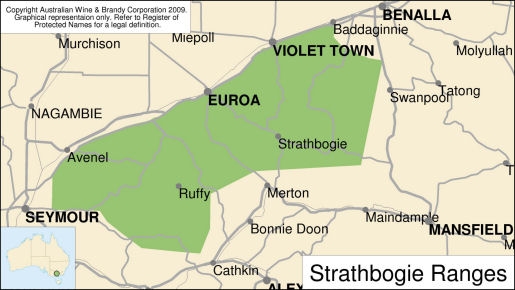
Strathbogie Ranges Wine Region
Climate
The region's lower north-western parts adjoining Euroa are quite warm and suitable for full bodied red wines but as the terrain rises to the east it becomes much cooler and more suitable for finer table wines. The season is characterised by cold, wet winters, widely variable spring weather, dry and warm to hot summers, and lingering autumns of warm clear days and cool, crisp nights. The ample rainfall occurs principally in winter to early spring. Spring frosts are an occasional hazard, as are hot northerly winds during ripening.
Soil
The vineyards are generally situated on alluvial/colluvial sands and sandy loams composed of decomposed granite that is rather acidic (pH 4-5). These soils are often littered with fractured quartz and ironstone gravel over clay or solid doleritic granite.
Wines
Chardonnay: Due to the region's altitude, these are elegant, cool-area wines recalling melon and lime characteristics in both nose and flavour. On the palate their normally good acidity means they mature quite well over the two to three-year medium term, by which time the wines have taken on more developed stone fruit flavours.
Sauvignon Blanc: The usual fresh herbaceous character of this variety on nose and palate are the norm on these Ranges.
Pinot Noir: When vinified in this region for table wine, Pinot Noir offers a good colour and often shows ripe strawberry traits on nose and palate. The quite high elevation of this region is possibly about the northernmost limit within which the variety can display its traditional delicacy, fine aromas and flavours.
Shiraz: The region's Shiraz wines are typically excellent, full-fruited styles of good colour and spicy berry aromas. The wines show elegance and style, achieving a balance between the very cool and warmer regions in Australia.
Vital Statistics
| Map Coordinates | 37º 12´ S |
|---|---|
| Altitude | 160 - 600 m (525 -1968 feet) |
| Heat degree days, Oct-Apr | 1460 (cut off at 19ºC (66.2 ºF) but otherwise not adjusted) |
| Growing season rainfall, Oct-Apr | 320 - 380 mm (12.5 - 15 inches) |
| Mean January temperature | 20.7º C (69ºF) |
| Relative humidity, Oct-Apr, 3 pm | Average 47% |
| Harvest | Mid Mar - mid May |