Goulburn Valley


Overview
Made up of a northern (downstream) and southern (upstream) end, Goulburn Valley has a detailed history dating back to first vineyard plantings in 1860. Scattered with lakes, billabongs and creeks, the region is not short of water, and vines regularly produce generous yields that aren't compromised for colour or flavour. Goulburn Valley boasts the oldest and largest plantings of Marsanne in the world.
The Big Picture
Both ends of the Goulburn Valley have a rich history. The southern end is intimately connected with the turbulent events of 1860 that led to the formation of a public company to fund the establishment of Tahbilk. The "old cellars" were completed at the end of the 1860s and the "new cellar", sitting underneath the immaculately preserved wooden winery buildings, commenced in 1875. Tahbilk still produces a few hundred cases of wine each year from vines planted in the 1860s, which are a priceless inheritance for future generations. The area around Tahbilk and Mitchelton is now registered as a subregion known as Nagambie Lakes.
At the northern end, Trojano Darveniza established the Excelsior Winery at Mooroopna, near Shepparton, in 1868 and by 1890 had won 300 awards in overseas competitions. Today Monichino is the principal winery in this section of the valley.
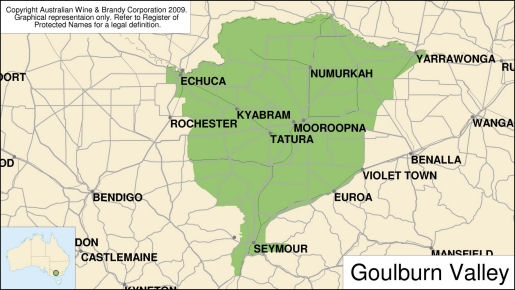
Goulburn Valley Wine Region
Climate
The region is distinctly warm, with a typical inland valley-floor climate and substantial diurnal temperature ranges. The heat is mitigated by the abundance of lakes, billabongs and creeks associated with the meandering Goulburn River, as well as by occasional river breezes. Abundant water for irrigation and loose textured sandy, gravelly soils typically produce generous yields without compromising colour or flavour.
Soil
The soils vary widely, falling into three principal groups. There are the usual red and brown sandy clay loams of south-eastern Australia, plus yellow-brown clay loams and gritty, gravelly quartzose sands laid down by the prehistoric wanderings of the Goulburn River. It is those sandy soils, often outcropping, which have held phylloxera at bay in an area infested by the pest.
Wines
Chardonnay: This is a wine of rapidly increasing importance which flourishes in the valley and the nearby Strathbogie Ranges region. In the valley it is capable of producing good yields at high sugar levels, with a peachy, buttery richness attesting to the climate. For a wine with a greater degree of elegance and style, a portion of Strathbogie Ranges Chardonnay is sometimes added to provide an extra dimension of tangy grapefruit and melon flavour to the palate. Instead of being a fast developing wine, in this region it is slow to mature.
Riesling: For reasons that are not readily apparent from the climatic data, the Central Goulburn area produces an excellent Riesling, which is among the best in Victoria. The wines have considerable weight, with intermingled marked lime juice and tropical fruit aromas and flavours. Despite their early appeal, the wines also have the capacity to age attractively over the medium term.
Cabernet Sauvignon: Throughout the 1970s, '80s and the early '90s it seemed the march of Cabernet Sauvignon was endless. Today its place is assured, with virtually all wineries, large and small, producing a wine style that usually has ripe, warm, earthy, chocolate-accented flavours.
Marsanne: The Goulburn Valley boasts the oldest and largest plantings of Marsanne in the world. Lemon-accented, the oaked styles gain in intensity and richness with age. Unoaked the wine is delicate in its youth but in the best years is extremely long-lived, building the honeysuckle bouquet and taste that typifies the variety.
Shiraz: The principal grape grown in the Goulburn Valley for over a century, Shiraz remains capable of producing a red wine of awesome flavour and longevity and is amenable to oak influence. The wines present ripe, rich fruit overtones when young and, with age, reveal the flavours of darker fruits, with hints of pepper, dark chocolate, soft supple leather and earth. It is the Shiraz, not the Cabernet Sauvignon, which dominates the recent plantings on the central valley floor.
Vital Statistics
| Map Coordinates | 36° 42' S |
|---|---|
| Altitude | 130-350 m (427 - 1148 feet) |
| Heat degree days, Oct-Apr | 1694 (cut off at 19ºC (66.2 ºF) but otherwise not adjusted) |
| Growing season rainfall, Oct - Apr | 250 mm (10 inches) |
| Mean January temperature | 21.2ºC (70ºF) |
| Relative humidity, Oct-Apr, 3 pm | Average 40% |
| Harvest | Early Mar–Early May |