Bendigo


Overview
For well over a century, the gentle rolling hills which fold away from the granite outcrops of the ranges of central Victoria have been home to some of the great wines of Australia. The first grapes were planted in the Bendigo region in 1856, just after the start of the Gold Rush which brought tens of thousands of hopeful diggers from all over the world to seek their fortunes.
The Big Picture
The tradition of wine grape growing in the Bendigo region is nearly as old as Bendigo itself. Credited by 19th century wine writer de Castella with being Bendigo’s first vignerons are Jacques Bladier and a German named Delscher, both of whom planted vineyards at Epsom about 1855, and Jean-Baptiste Loridan, whose vineyard of 10,000 vines on the Sheepwash Creek was noted in the May 1856 Bendigo Advertiser as being two years old.
The connection between the discovery of gold and the proliferation of vineyards is made in a number of ways. Benwell believes that when the "easy gold" ran out, viticulture was something which "the scattered labour force, uncommitted, used to hard work and still ready to gamble" could easily turn to. But the lasting legacy of grape growing and wine making in the Bendigo district is more to be found in those who benefited from the prosperity the Gold Rush produced while drawing upon skills and tastes acquired in their European homelands of Germany, Switzerland and France.
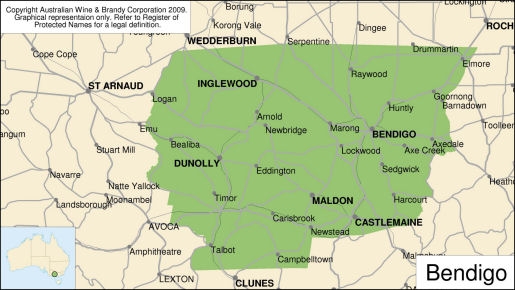
Bendigo Wine Region
Climate
Situated completely inland, the Bendigo region has a Mediterranean climate with warm, dry summers and mild, wet winters. There is some variation in mesoclimatic conditions due to elevation, slope and aspect, from the foothills of the central highlands (such as at Castlemaine, Harcourt and Elphinstone) to the warmer undulating plains west and north of Greater Bendigo. Overall, however, the region is classified, in terms of suitability for wine grape production, as a region with Mean January Temperature (MJT) from 21.0 to 22.9 C.
Compared with its neighbouring regions, Bendigo has higher daily mean temperatures during the ripening period, a lower daily range of temperatures, a lower relative humidity, and more sunshine hours at that time, while the average amount of rainfall is similar.
Soil
The majority of the soils fall in the very common south-east Australian group of brownish, loamy sand to clay loam soils over a stony clay base. However, there are significant patches of quartz gravel subsoils which have, or once had, the potential to be gold bearing. Overall, the soils are acidic and fairly low in nutrients, needing the application of lime, gypsum and supplementary water if reasonable yields are to be obtained. The tendency to low yields is undoubtedly the reason why the region provides red wines of such depth and strength.
Wines
White Wines: Almost inevitably, Chardonnay dominates the white grape plantings, proving once again that it can be successfully grown and made in almost any combination of climate and soil. Creditable Riesling is also produced.
Cabernet Sauvignon: Cabernet Sauvignon also excels in this region. There is a character within this grape that is evident right across central Victoria, from Great Western to the Pyrenees and onwards, in slightly diminishing strength, to the Goulburn Valley. One hundred years ago, Francois de Castella recorded that the red wines of the Bendigo region were noted for a “faint curious character, resembling sandalwood” and that this character persisted even in brandy distilled from the wine. In modern " winespeak", the term mint (meaning mint in the eucalypt-to-peppermint spectrum, as opposed to garden mint) is used to describe this character. Its intensity varies from vintage to vintage and from wine to wine but it is seldom entirely absent. The wines have great depth of colour, a rich texture with abundant tannins, and fruit flavours ranging from faintly tobacco and herbaceous (in the coolest years) through to the far more common blackberry and black currant flavours. They are long-lived wines with excellent cellaring potential.
Shiraz: This is the great red wine of the region. The colour is deep and the wine almost voluptuous in the way the flavour and texture fill the mouth. Pepper and spice may accompany mint, but it is frequently replaced with red berry and sometimes cherry fruit to support these more exotic flavours. It is every bit as long-lived as Cabernet Sauvignon.
Vital Statistics
| Map Coordinates | 36° 45´ S |
|---|---|
| Altitude | 240 - 390 m (787 - 1279 feet) |
| Heat degree days, Oct-Apr | 1579 (cut off at 19ºC (66.2ºF) but otherwise not adjusted) |
| Growing season rainfall Oct-Apr | 267 mm (10.5 inches) |
| Mean January temperature | 21º C (7oº F) |
| Relative humidity, Oct-Apr, 3 pm | Average 40% |
| Harvest | Mid Mar-End Apr |