Barossa Valley


Overview
With a rich winemaking and grape growing heritage dating back to 1842, and a profound and unique Silesian (German) influence, the Barossa Valley is probably Australia's most famous wine region. It is now rightly asserting not only its importance to the wine sector but also the inestimable value of its storehouse of century-old vines and historic wineries.
The Big Picture
The twists and turns of the Barossa Valley are at times clearly defined. At other times they disappear into a series of rolling hills and transverse valleys, providing endless discoveries of charming hidden landscapes. In consequence, site, slope and aspect all vary widely throughout the region.
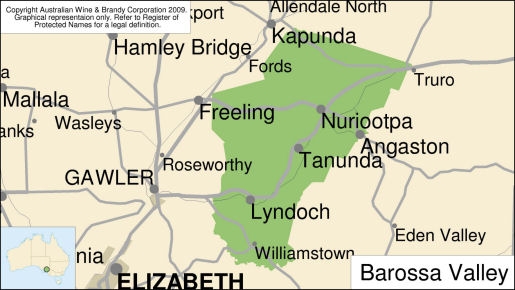
Barossa Valley Wine Region
Climate
The climate of the region has often been unfairly characterised as very warm but in its lower parts it is only moderately so and at higher altitudes quite cool. In fact, as Dr John Gladstones has pointed out, its biologically effective temperature summation and ripening mean temperatures are almost identical with those of Margaret River. However, the region does have a wide diurnal temperature range, higher maxima, more sunshine and a much lower humidity and rainfall. All of this adds up to a Continental climate ideal for full-bodied red wines, excellent fortified wines and generally robust white wines.
Soil
The complex system of transverse sub-valleys and twisting hills results in a multiplicity of varying slopes, aspects and sites. The soils vary widely, but fall in an overall family of relatively low-fertility clay loam through to more sandy soils, ranging through grey to brown to red. As in so much of south-east Australia, acidity increases in the subsoils, restricting root growth and vigour.
Wines
Chardonnay: Has some parallels with Semillon; reduced skin contact and better oak (more French) now makes generous, if relatively quick-developing, styles.
Riesling: Here too generosity rather than finesse or elegance rules the day, with wines which develop far more quickly than their counterparts from the Eden or Clare Valleys. Most Barossa-branded Rieslings are made from Eden Valley grapes.
Semillon: Once a dark horse, is now a charging white stallion. Gone are the days of coarse and phenolic skin-contacted wine and American oak; in are earlier-picked, steel-fermented wines of real merit and clear varietal character.
Grenache and Mourvedre: Grenache is often blended with Shiraz and Mourvedre, but is also presented as a varietal in its own distinctive right ─ juicily sweet, almost jammy (the best examples stop short of this). The two and three varietal blends display a rich tapestry of flavours and textures.
Cabernet Sauvignon: Performs best on cooler sites and in moderately cool vintages. French oak is largely but not universally preferred to American, and the overall style is more restrained and firmer than that of Shiraz.
Shiraz: Shiraz is, by a considerable distance, the best wine grown in the Barossa Valley. Traditional American oak maturation is in part yielding to some use of French oak, and the co-fermentation of 2% or less Viognier has proved highly successful. The wines are lush, velvety and mouthfilling, with flavours in the black cherry to blackberry spectrum, the tannins ripe and soft. A certain amount of controversy exists over the levels of extract and alcohol, which have excited much approval and high prices in the US.
Vital Statistics
| Map Coordinates | 34° 29'S |
|---|---|
| Altitude | 250 - 370 m (820 - 1213 feet) |
| Heat degree days, Oct-Apr | 1710 (cut off at 19º C (66.2ºF) but otherwise not adjusted) |
| Growing season rainfall, Oct-Apr | 160 mm (6.3 inches) |
| Mean January temperature | 21.4°C (70°F) |
| Relative humidity, Oct-Apr, 3 pm | Average 39% |
| Harvest | End Feb - Late Apr |