Clare Valley


Overview
James Halliday has described the Clare Valley as one of Australia’s most beautiful wine producing regions. Hills fold in on themselves, streamlets meander and lines of gumtrees are forever twisting through pockets of vineyards and around old stone houses.
The Big Picture
Situated in the northern Mt Lofty Ranges, South Australia’s Clare Valley was settled in the late 1830s, with the first vineyards planted and wines produced in the early 1840s. The region is now home to about 50 wineries, with the region producing around 2% of the Australian grape crush.
The same features that make the Clare Valley inherently beautiful – steep north-south ranges rising from the flats to the west, deep narrow gullies, high windswept plateaus, wide open valley floors and austere slate escarpments – are the foundation of Clare’s famed vineyards.
While a traditional region of great history and mature vineyards, the winemakers of Clare could not be accused of resting on their laurels. In a co-operative effort, they decided to start producing their Riesling sealed with a screwcap in the late 1990s. Their pioneering work has seen this type of wine bottle seal widely adopted in many other parts of the world.
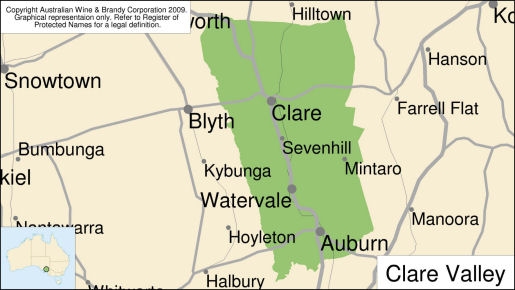
Clare Valley Wine Region
Climate
Although much has been written about the climate of this region, in many ways it is difficult to reconcile with its wine styles. Its weather data point to a far warmer climate than is the case; cool afternoon breezes are the key and play a major role in slowing down the ripening process. Furthermore, altitude and position within the Valley, as well as aspect, lead to considerable variations in individual site climate. Overall, however, the climate is moderately Continental, with cool to cold nights and warm to hot summer days. The rainfall is winter-spring dominant, while relatively low humidity (and summer rainfall) means a low incidence of fungal disease.
Soil
Soils of the Clare Valley range from classic terra rossa red topsoil over limestone in the Watervale district to the broken slate of Polish Hill River. The vineyards at the northern end of the valley are planted in deep fertile alluvial ground, where there is little or no need for irrigation. Vineyards in the Skillogalee Valley, to the west of the main valley, are planted into sandy loams with varying amounts of degraded quartz.
Typically the soils from most areas of the valley are free-draining and hold enough water to only require the smallest quantities of supplementary irrigation during the hottest months.
Wines
Riesling: The Clare Valley is renowned as a premier producer of dry Riesling styles. The wines are characterised by juicy citrus characters, minerality and long, fine natural acidity. The style the region is famous for has no oak influence, and the best examples have been proven to age for 20-plus years. The older examples develop extra texture and a toastiness if cellared in good conditions. While many parts of the Clare Valley have been proven to make great Riesling, there has been a focus by many producers on the subregions of Watervale and Polish Hill River. The vineyards of Watervale are predominately grown on limestone and produce a juicier Riesling, whereas the vineyards around Polish Hill River are grown on mainly slate, producing wines that are more tightly focussed.
Shiraz: The Clare Valley produces Shiraz that has fragrance, power, structure and finesse. Typical fruit characteristics are red berries, spice and chocolate. The wines are underpinned by powerful yet soft building tannins, and the best examples have long cellaring potential.
Cabernet Sauvignon: The Clare Valley makes a distinctive regional style of Cabernet with dark berries, chocolate and cigar box being typical characters. The wines are characterised by a juicy mid-palate and long fine tannins. The combination of warm days and cool nights contributes to wines of concentration, fresh fruit character, density and elegance. Cabernet Sauvignon from Clare can be particularly long lived. Cabernet Malbec blends are also considered a regional speciality.
Semillon: Semillon grown in Clare can be characterised as having lemon and/or tropical fruit characters. The wines have good fruit concentration and are rich in character with juicy acidity. The best examples can develop further richness with time in bottle.
Grenache: While not a widely planted variety in Clare, several producers make wines of concentration . Old vines produce wines that are full of flavour, spice and richness.
Vital Statistics
| Map Coordinates | 33 50oS |
|---|---|
| Altitude | 400 - 500m (1312 - 1640 feet) |
| Heat degree days, Oct-Apr | 1770 |
| Growing season rainfall, Oct-Apr | 200 mm (7.9 inches) |
| Mean January temperature | 21.9 C (71.42 F) |
| Relative humidity, Oct-Apr, 3 pm | 37% |
| Harvest | February - April |