Riverland


Overview
The Riverland is Australia’s largest wine producing region, accounting for over one quarter of the national grape crush. The Murray River nurtures the region’s grapevines, which produce warm, fruit-driven styles of wine that have underpinned much of Australia’s export success in recent decades.
The Big Picture
The Riverland has a crucial place in Australia’s "food bowl", where winegrapes coexist with citrus orchards and almond plantations. The days are warm and the ample sunshine ripens the fruit to produce wines of generous and attractive flavours. The Murray also supports some of Australia’s most distinctive wildlife – the Riverland is well regarded as a bird lover’s paradise.
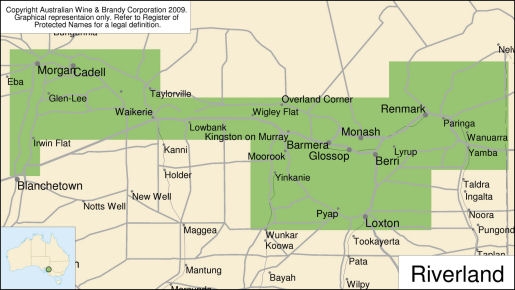
Riverland Wine Region
Climate
The Riverland climate is Continental, resulting in long sunny days and noticeably cooler nights. Modern viticultural and winemaking techniques mean the climate can be seen as one of the region’s strengths. Long sunshine hours ensure fruit ripens fully and low relative humidity results in clean and attractive winegrapes.
Soil
The soils of the Riverland vary significantly. The two main types are river valley soils, consisting of sandy loams over clay subsoils, and Mallee soils on higher ground, consisting of wind-blown sands over lime and clay layers. Soils within the river valley, comprising loams and clays, were formed when fine clay and silt particles were deposited over the flood plain by the River Murray. On higher ground the Mallee landscape is characterised by depressions and rises and consists of windblown sands over lime and clay layers.
Wines
Chardonnay: The Riverland boasts more Chardonnay plantings than the combined total of other regions in South Australia. Combined with technologically advanced winemaking, Riverland Chardonnay often exhibits vivacious and ripe flavours. Oak is often but not always used, and this supports the richness of the wines, adding further complexity.
Shiraz: Shiraz is currently the most significant red winegrape variety. It responds well to the region’s conditions and the resulting wines are often soft and ready-to-drink. However, with different approaches to managing the vines, Riverland Shiraz can express itself with deeper colours and concentrated flavours. Dark berries and plums are terms commonly used to describe the scent of Riverland Shiraz.
Cabernet Sauvignon and Merlot: Cabernet Sauvignon and Merlot are also prevalent . Each is used as single varietal wines and in blends. The region’s warm temperatures tend to bring out the richer raspberry characteristics in the wines, while in cooler years the overall profile can demonstrate plenty of mint and blackcurrant.
Petit Verdot: It can be used as a blending variety to add opulence and fruit power, but Petit Verdot also has demonstrated significant potential as a single varietal. Many producers are making small amounts of reserve wine from this quiet achiever, increasingly winning awards and accolades. Kingston Estate has one of the world's largest plantings of Petit Verdot. Common characteristics include fresh spice, pepper, dark fruit characters and the tell-tale impression of violets.
From Albarino to Zinfandel: As the region continues to grow and adapt to new conditions, winegrape growers and winemakers continue to explore new grape varieties with the view to delivering high-quality and delicious wines.
Some parcels of Chardonnay and Pinot Noir are harvested early in the season and used to make sparkling wine. Select patches of Shiraz and Cabernet Sauvignon are also picked at the beginning of the ripening season to produce delicate Rosé style wines. For full bodied wines, grapes are carefully harvested at optimum maturity to produce both single variety and blended table wines. A number of popular fortified wines and brandies are also carefully crafted from Riverland wine grapes.
Vital Statistics
Statistics from three weather stations are given.
| RENMARK WEATHER STATION 1889-2003 (EASTERN SECTOR) | |
|---|---|
| Map Coordinates | 34°10’S, 140°45’E |
| Altitude | 20m (65.6 feet) |
| Heat degree days, Oct-Apr | 2084 (cut off at 19°C (66.2°F)(but otherwise not adjusted) |
| Growing season rainfall, Oct-Apr | 135 mm (5.3 inches) |
| Mean January temperature | 24.6°C (76°F) |
| Relative humidity, Oct-Apr, 3 pm | Average 33% |
| Harvest | Mid Feb-mid Apr |
| WAIKERIE WEATHER STATION 1896-2001 (WESTERN SECTOR) | |
| Map Coordinates | 34°11´S, 139°59´E |
| Altitude | 30.1m (98.4 feet) |
| Heat degree days, Oct-Apr | 2084 (cut off at 19°C (66.2°F) but otherwise not adjusted) |
| Growing season rainfall, Oct-Apr | 133 mm (5.2 inches) |
| Mean January temperature | 24.1°C (75.4°F) |
| Relative humidity, Oct-Apr, 3 pm | Average 30% |
| Harvest | Mid Feb-Mid Mar |
| LOXTON RESEARCH CENTRE WEATHER STATION 1984-2003 (SOUTHERN SECTOR) | |
| Map Coordinates | 34°26´S, 140°36´E |
| Altitude | 25m (82 feet) |
| Heat degree days, Oct-Apr | 2084 (cut off at 19°C (66.2°F) but otherwise not adjusted) |
| Growing season rainfall, Oct-Apr | 130 mm (5.1 inches) |
| Mean January temperature | 22.8°C (73°F) |
| Relative humidity, Oct-Apr, 3 pm | Average 32% |
| Harvest | Mid Feb-mid Apr |