McLaren Vale


Overview
Where the vines meet the sea you will find the beautiful wine mecca that is McLaren Vale. With an idyllic location, a Mediterranean climate with cool maritime influences, and passionate winemakers and grapegrowers, it is no wonder McLaren Vale continues to punch above its weight. The region produces award winning wines and is enjoying a steady increase in visitor numbers, year in year out.
The Big Picture
Enthusiastic, energetic and passionate are words often used to describe people who live and work in McLaren Vale. The unique marriage of a wine region and beach lifestyle has created a melting pot for all things culinary, vinous and artistic.
McLaren Vale has a rich history of success and is widely recognised as one of Australia’s greenest wine regions because of its ongoing water use efficiency strategies and commitment to environmental sustainability. This was evident in the launch of its region-wide environmental management plan in 2007. Minimal chemical pest and disease management is the norm in the Vale, and efficient water use is a major part of the region’s environmental focus.
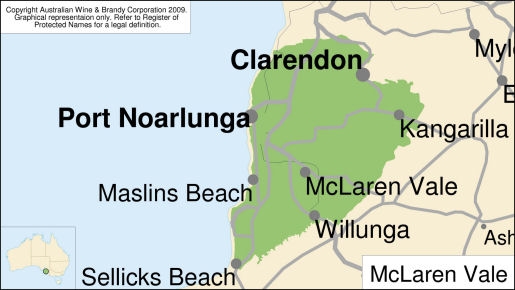
McLaren Vale Wine Region
Climate
There is substantial meso-climatic variation throughout McLaren Vale, due to varying exposure to the cooling influence of the nearby ocean (or conversely to protection from it). There are also significant changes in altitude as the region merges with the Adelaide Hills. Summer rainfall is low, and supplementary irrigation is considered essential. Site selection and the marriage of site to variety are all-important; Shiraz, Cabernet Sauvignon, Grenache, Semillon, Sauvignon Blanc and Chardonnay all do very well in the appropriate location.
Soil
There is a wide variety of soil types, a reflection of the varied terrain; red-brown sandy loams, grey-brown loamy sands with yellow clay subsoils interspersed with lime, distinctly sandy soils and patches of red or black friable loams are all to be found. As the long-standing and intensive viticulture attests, most soils in the region are well suited to grape growing.
Wines
Cabernet Sauvignon: McLaren Vale’s signature variety that continues to win awards locally and internationally. The wines are full bodied and rich, often with a touch of dark chocolate intermixed with black currant, but they avoid overripe, jam-like characteristics. The tannins are plentiful but soft, and the wines have the structure for long aging.
Grenache: This variety has enjoyed a spirited renaissance during the last decade. The older plantings produce incredibly richly flavoured wines, with an almost juicy sweetness.
Shiraz: For much of the 20th century, as in so many of the premium wine growing districts of Australia, Shiraz was the backbone of the industry. It produces a densely coloured, richly flavoured wine that quickly develops a velvety texture and carries high alcohol levels with ease.
Chardonnay: Since its introduction a little over 15 years ago, Chardonnay has, not surprisingly, established a stranglehold on white grape plantings in the region. The style varies according to site, winemaker input and vintage conditions, ranging from elegant, citrus-tinged wines through to richer, fleshier, peachy and buttery versions.
Sauvignon Blanc: The cooler sites in McLaren Vale are well suited to Sauvignon Blanc. While vintage variation does play a role, in most years the wines have excellent varietal character, tending to gooseberry and tropical fruit rather than more weedy, grassy flavours without becoming coarse or heavy. Semillon is often incorporated to very good effect as a blend component.
Other Varities: The climatic diversity has helped McLaren Vale producers to successfully embrace varieties such as Barbera, Fiano, Tempranillo, Mourvedre and Moscato, and explore re-emerging varieties like Viognier, Sangiovese, Zinfandel and Verdelho.
Vital Statistics
| Map Coordinates | 34° 14'S |
|---|---|
| Altitude | 50 – 200 m (164 - 656 feet) |
| Heat degree days | 1910 (cut off at 19ºC (66.2º F) but otherwise not adjusted) |
| Growing season rainfall, Oct-Apr | 180 mm (7 inches) |
| Mean January temperature | 21.7°C ( 71°F) |
| Relative humidity, 3 pm | Average 46% |
| Harvest | Feb - Late April |