Southern Fleurieu


Overview
The vineyards and wineries of the Southern Fleurieu Peninsula are but one of numerous tourist attractions in the region. The undulating slopes and gentle hills pose no limitations to viticulture and simply serve to enhance the beauty of the vineyards within such a diverse landscape.
The Big Picture
The Southern Fleurieu region is distinct from any other and the quality of the wines made to date will almost certainly lead to further plantings and developments.
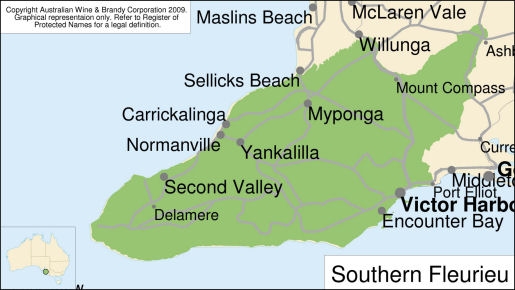
Southern Fleurieu Wine Region
Climate
The climate is Mediterranean and very strongly influenced by the vast expanses of water surrounding the region. Temperatures are one to two degrees warmer than Adelaide in winter, but three to five degrees cooler in summer, with an average summer maximum of only 25°C (77°F).
The Mediterranean pattern means rainfall is winter dominant and the minimal growing season rainfall makes irrigation essential. Spring frosts are simply not an issue, and the prevailing southerly winds seldom blow with sufficient force to inhibit growth. Overall, the climate is cooler than one envisages and reflects itself in the wine styles.
Soil
There are two soil types in the vineyard areas: a variable sandy to more clayey loam over limestone subsoil, and buckshot gravel, again over limestone. Both are suited to viticulture and support moderately vigorous vine growth.
Wines
Riesling: Made in dry and semi-dry style, the latter no doubt reflecting the importance of the general tourist cellar door trade upon which the wineries are reliant. As is the case in virtually all Australian regions where Riesling and Cabernet dominate, it performs well and provides a crisp, tasty wine in its dry version but also lends itself to being made in a sweeter style.
Cabernet Sauvignon: This late ripening variety provides positive proof, at least in some vintages, of the temperate climate, which may indeed be even cooler than the statistics suggest. In the warmer years the region produces a wine with a most attractive mix of gently herbaceous and tobacco characters, with sweeter red and blackberry flavours. The tannins are fine and supple, and the wine is of medium body. In the cooler vintages, herbaceous characters are more evident, though not unpleasantly so.
Merlot: This wine is sometimes made as a straight varietal and at other time blended with Cabernet Sauvignon. If there is to be significant expansion of plantings in the region, Merlot should be one of the front runners. Not only is it in demand overall, but it appears particularly well suited to the climate and soil of the Peninsula, producing wines of vibrant varietal character. The flavours run through a spectrum of leaf, mint and red berry, with an appropriately fragrant bouquet.
Vital Statistics
| Map Coordinates | 34º 44´S |
|---|---|
| Altitude (region) | 250 m (820 feet) |
| Heat degree days, Oct-Apr | 1628 (cut off at 19ºC (66 2 º F) but otherwise not adjusted) |
| Growing season rainfall, Oct-Apr | 121 mm (4.8 inches) |
| Mean January temperature | 19.6°C (67 °F) |
| Relative humidity, Oct-Apr, 3 pm | Average 59% |
| Harvest | Mid Feb–April |