Currency Creek


Overview
Currency Creek is located across from the Southern Fleurieu region and below the Langhorne Creek region and has a viticultural history dating back to 1969.
The Big Picture
Captain Charles Sturt first explored this region when he travelled down the Murray River in 1829-30 and made his last campsite near what is now the town of Goolwa. In 1837 the town of Currency Creek was officially named and three years later an elaborate town plan was laid out.
Over the next 50 years agriculture, river transport and recreation developed, but it was not until 1969 that the first vines appeared; Wally and Rosemary Tonkin planted one acre each of Riesling, Grenache, Shiraz and Cabernet Sauvignon. Despite local cynicism, the vines flourished and the first vintage followed in 1972 for what was then Santa Rosa Winery and is now known as Currency Creek Winery. In that same year the first vines were successfully planted on 2.6 hectares (6.5 acres) at what today is the Middleton Winery.
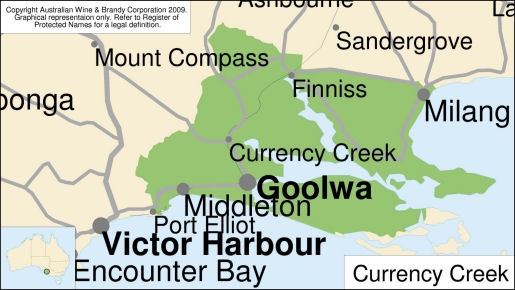
Currency Creek Wine Region
Climate
The climate is slightly warmer than that of Langhorne Creek and on a par with Margaret River and California's Carneros. In common with those regions, it is a strongly maritime climate due to Lake Alexandrina and the Southern Ocean, thus avoiding extremes of cold or heat. There has been only one September day of frost in the past 37 years, and no hail or fog. Excellent ground water is readily accessible through bores and there are no restrictions on its use.
Soil
Plantings are on the dominant rolling sandy slopes, which allow easy infiltration of water into the overlaying friable cracking clays that are easily accessed by the roots of the vines. The other suitable soils are loams with red alkaline clayey subsoils.
Wines
Sauvignon Blanc: This was one of the wines to bring attention to Currency Creek in the early days, courtesy of the Tonkin family and Petaluma. The wines have delicacy and freshness, with greater varietal definition than with other similar wine.
Cabernet Sauvignon: A variety ideally suited to the temperate, mild climate of the region, producing complete and rounded wines with clear varietal definition. As the ripening curve increases, the flavours move from coffee to blackberry and on to black currant at optimum ripeness. The style has more similarity with that of Coonawarra than with others with which it may be compared.
Merlot: Although not widely planted, Merlot performs very well, with good perfume and varietal character, and provides a synergistic blend with Cabernet Sauvignon. There is also potential as a varietal wine in its own right.
Shiraz: This wine has an elevated aroma that precedes the medium-bodied, low tannin and Rhone Valley-like spicy fruit flavour that greets the palate with elegance and finesse. It is arguable that in a normal vintage the area is a fraction too cool for this variety to show its best.
Vital Statistics
| Map Coordinates | 35°29'S |
|---|---|
| Altitude | 50-70 metres (164-230 feet) |
| Heat degree days, Oct-Apr | 1525(cut off at 19ºC (66.2ºF) but otherwise not adjusted) |
| Growing season rainfall, Oct-Apr | 155 mm (6.1 inches) |
| Mean January temperature | 18.5° (65°F) |
| Relative humidity, Oct-Apr, 3 pm | Average 64% |
| Harvest | Early Mar - Mid Apr |