Langhorne Creek


Overview
Langhorne Creek has a history of viticulture dating back to 1860 and is known for its flat, river delta landscape. The region ideally suits large-scale, relatively low-cost vineyard developments where a high degree of mechanisation is common.
The Big Picture
Langhorne Creek Shiraz and Cabernet Sauvignon are valued contributors to many red blends and a number of Australia’s larger winemakers, among them Beringer Blass, Hardy, Orlando and Southcorp, are represented in the region. Areas under vine tend to be large, with several holdings in excess of 300 hectares (740 acres). Such multi-million dollar investments emphasise that this is a remarkably good area for soft, fruity, medium-bodied red wines.
There are an increasing number of smaller wineries now based in the region, changing preconceived perceptions by producing regional red wines that retain an element of softness while adding richness and a remarkable concentration of colour and flavour.
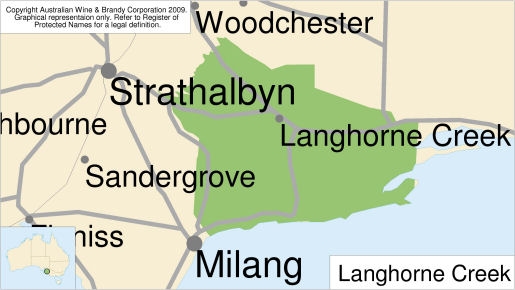
Langhorne Creek Wine Region
Climate
The growing season climate is predominantly shaped by the onshore southerly winds blowing directly from the Southern Ocean across Lake Alexandrina. While intermittently broken by periods of very hot weather associated with northerly winds emanating from central Australia, the prevailing southerlies normally reduce daytime temperature fluctuations. These southerlies also decrease sunshine hours and overall summer temperatures, while increasing the relative humidity. The winter-spring rainfall pattern persists. Irrigation is universally practised, in part by the unique method of diverting the Bremer River and deliberately flooding the land in late winter. Newer vineyards also use conventional drip irrigation.
Soil
Langhorne Creek’s fertile soils are predominantly deep, alluvial sandy loams that vary in colour from red-brown to dark grey, with patches of black, self-mulching clays. All soil types promote vine vigour, generous canopies and cropping levels.
Wines
Cabernet Sauvignon and Blends: While less than a quarter of the wine currently made from grapes grown in Langhorne Creek is sold as a single-region wine, the style is relatively easy to define. Generally the wines are immediately accessible, soft and fragrant. Flavours are in the red berry spectrum, often with some gentle minty and chocolate overtones though seldom herbaceous or tannic. As in the Clare Valley, Malbec adds a particular dimension when added to the blend, providing an almost riotously juicy wine with more cassis evident.
Shiraz and Blends: Often released as a single varietal but also blended with Cabernet Sauvignon, Merlot or Malbec, Shiraz produces strikingly fruity wines with flavours and aromas of cherry and mint. Its hallmark regional softness finishes with that hint of spice still remaining.
Verdelho: Although produced in relatively small quantities, the variety is a regional specialty, particularly as a fortified wine in the style of Madeira. Verdelho is increasingly handled as a soft, early-maturing table wine.
Vital Statistics
| Map Coordinates | 35° 15'S |
|---|---|
| Altitude | 30 m (98 feet) |
| Heat degree days, Oct-Apr | 1520 (cut off at 19º C (66. º2 F) but otherwise not adjusted) |
| Growing season rainfall, Oct-Apr | 140 mm (5.5 inches) |
| Mean January temperature | 19.9°C (67.8°F) |
| Relative humidity, Oct-Apr, 3 pm | Average 47% (Strathalbyn Gladstones) |
| Harvest | Early Feb - Late Apr |