Padthaway


Overview
Originally known as Keppoch, Padthaway was identified as a viticultural region in 1963 by Karl Seppelt on the basis of a study carried out 19 years earlier by the Commonwealth Scientific and Industrial Research Organisation (CSIRO) and the South Australian Department of Agriculture.
The Big Picture
The acquisition of 350 hectares (865 acres) by Seppelt encouraged first Lindemans, then Hardys and Wynns to follow suit and to this day Padthaway remains the preserve of the major companies. Notwithstanding the originally modest quality expectations held for the region by its pioneers, it has proved to be an excellent white wine producer and, if yields are controlled, an equally good red wine area.
The 1998 opening of the large, state-of-the-art Stonehaven Winery of Hardys Wines significantly increased awareness of the region and the quality of its wines. The winery's spectacular success at the 2000 San Francisco International Wine Competition, where it won top exhibitor and winemaker trophies, added further lustre.
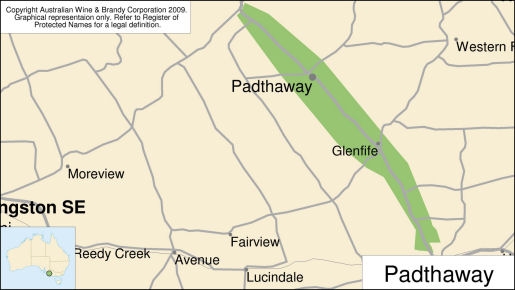
Padthaway Wine Region
Climate
Given the absence of any significant mountains, a maritime climate generally prevails. The region’s original bias towards white wines is surprising given that it is significantly warmer than Coonawarra to the south, with more sunshine hours, lower rainfall and fewer rain days. It was no doubt climatic statistics that led its founders to assume it would be more likely to succeed as a red wine area. Water availability is a severely limiting factor in an area of otherwise vast potential and irrigation is essential. Spring frosts are a major threat.
Soil
While the slopes are very gentle, there is variation within the landscape. Subtle differences in slope and elevation are important, not so much from a climatic viewpoint (although spring frosts are a danger) but rather as an indication of soil changes. In a 1944 CSIRO report the soil of the region was described thus: "The soil type which occurs in numerous small patches consists of a brown sandy loam over red-brown clay over limestone. This soil type is very variable in depth and there are usually some stony portions on each of the small patches in which it occurs. It is a terra rossa soil... the deeper sites of the terra rossa soils should make first class garden soils."
Wines
Chardonnay: Historically Chardonnay has been recognised as the most successful of the wines from Padthaway. There is a particular character to the fruit flavour which is evident in the majority of the vintages and which, without the intervention of oak, is strongly reminiscent of grapefruit, although the flavours also extend to more conventional notes of melon, fig and white peach.
Riesling: Once again, this wine is frequently used as a workhorse, albeit to good effect by major brands in the region. Intermittent releases of high quality botrytised Rieslings are among the best of this style to be found in Australia, with intense lime, apricot and cumquat aromas and flavours. The best withstand prolonged cellaring.
Cabernet Sauvignon: Released either as a single varietal or blended with Merlot, the wine is typically of medium body, fragrant and with cool (rather than warm) climate characteristics to the fore. The tannins are fine and soft and the wine does not need, nor is it usually given, significant oak influence. The wines enter the plateau of drinkability quite quickly but are capable of lingering on that plateau for many years. As with much of the wine from Padthaway, it is often blended with wines from other regions.
Pinot Noir: This wine is as temperamental in Padthaway as in any other region but by and large, and against all of the climatic indications, when used to make table wine it has done better in Padthaway than expected. One or two truly outstanding wines have been produced over the years, with some impressive mid-priced wines appearing recently.
Shiraz: As in Langhorne Creek, very little Padthaway Shiraz is seen under a regional label and for similar reasons. Many companies seek out Padthaway Shiraz for blended brands and willingly promote its use on their labels. However, many Shiraz varietals from this region have enjoyed great success in national and consumer shows.
Vital Statistics
| Map Coordinates | 36° 37'S |
|---|---|
| Altitude | 50 m (164 feet) |
| Heat degree days, Oct-Apr | 1610 (cut off at 19ºC (66.2 ºF) but otherwise not adjusted) |
| Growing season rainfall, Oct-Apr | 180 mm (7 inches) |
| Mean January temperature | 20.4º C (68.7 ºF) |
| Relative humidity, Oct-Apr, 3 pm | Average 45% |
| Harvest | Mar-Apr |