Wrattonbully


Overview
Hardworking farming pioneers settled the Wrattonbully region in 1842, and today the area is still known for its world-class livestock, wool and crops. The first vines for winegrapes were planted in the late 1960s, but it was not until the 1990s that the excellent soils and elevated sites attracted many winemakers from surrounding areas. The potential promised by the large tracts of outstanding terra rossa soils over limestone is now being realised in wine quality, as these vineyards mature and winemakers understand the unique characteristics of Wrattonbully fruit.
The Big Picture
Wrattonbully lies over several ranges, including Stewarts Range, the Naracoorte Range (also known as the Kanawinka escarpment, the original coastline of the continent of Gondwanaland), the Caves Range and Hynam Range. During successive periods of glaciation, 14 stranded shorelines were left between the Naracoorte Range and the current coastline. Wind blown organic material accumulated on top of these limestone reefs and formed the famous terra rossa soils. The limestone that forms the ridges is from the Miocene era (5-25 million years old).
Wrattonbully has been specifically chosen by many of Australia’s leading wine producers, as well as by passionate locals, for its ideal viticultural attributes – terra rossa soil over limestone, good quality underground water, long growing season and cool climate.
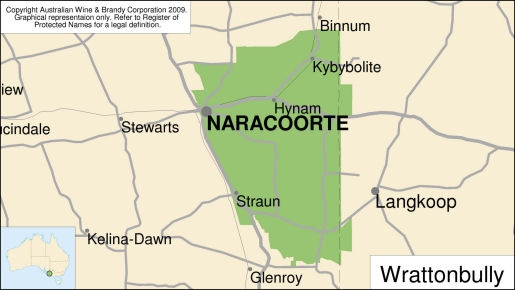
Wrattonbully Wine Region
Climate
The climate is poised between that of its neighbours, Coonawarra and Padthaway; slightly warmer than the former and cooler than the latter, although there is surprisingly little variation across the three regions. Relative humidity (and hence the risk of disease) is slightly lower than in the other two regions, and the risk of frost is significantly less. Rainfall in Coonawarra and Wrattonbully is virtually identical. There is sufficient underground water of appropriate quality (salinity is not a problem) to irrigate 10,000 hectares (24,711 acres) of vines if no other irrigated agriculture is being conducted. As the statistics indicate, this is a temperate region and especially well suited to the production of high-quality red wines.
The existence of the ranges within the region has permitted the establishment of vineyards at an elevation of 75 to 100 metres (246 to 328 feet) on gently hilly slopes. This facilitates cold air flow and, combined with the elevation, provides a significant measure of frost protection.
Soil
The vineyards of Wrattonbully share the terra rossa soils so famous in Coonawarra; these derive from the ancient coastal dunes and seabed formations that give the Limestone Coast its name. Fertility is moderate to high, thanks to the very good structure and the neutral to mildly alkaline chemical balance. Substantial yields are achieved without loss of quality.
Limestone caves are a feature of the area, and the Wrattonbully region is home to the World Heritage Listed Naracoorte Caves.
Wines
Cabernet Sauvignon: This variety easily dominates plantings in the region, with about 1,200 of the 2,600 hectares planted in the area being Cabernet Sauvignon. It ripens easily, even when crop levels are generous, producing a pleasantly soft, red berry fruited wine with complex tannins.
Shiraz: Planted on about 700 of the 2,600 hectares under vine in the region, Shiraz is the second most widely planted variety in Wrattonbully. The region’s long growing season, culminating in a dry and sunny April, makes it easy to bring to optimum ripeness.
Merlot: Approximately 330 hectares of Merlot are planted in Wrattonbully. The Merlot produced is soft, rich and fruit driven, with good power and flavour.
Chardonnay: This is the fourth most widely produced variety, with about 230 hectares planted. Although Wrattonbully is know mainly as a red grape area, Chardonnay of great character and flavour, with good acid structure, is produced.
Vital Statistics
| Map Coordinates | 40° 45'S |
|---|---|
| Altitude | 75-150 m (246-492 feet) |
| Heat degree days, Oct-April | 1468 - 1535 (cut off at 19ºC (66.2º F) but otherwise not adjusted) |
| Growing season rainfall, Oct-Apr | 205 - 232 mm (8 - 9 inches) |
| Mean January temperature | 19.4 - 20.5°C (67 - 69°F) |
| Relative humidity, Oct-Apr, 3 pm | Average 43% |
| Harvest | Mid Mar–Mid May |