Coonawarra


Overview
The Coonawarra region is located in the far south-east of South Australia. Neighbouring wine regions include Wrattonbully and Mount Benson. The region has a long viticultural history dating back to 1890.
The Big Picture
First planted to vines in 1890, the Coonawarra district has evolved through three distinct historical periods. The first was the era of the Penola Fruit Colony, and the early settlers such as the Redman family who, by dint of hard work, brought to reality the vision of its Scottish founder, John Riddoch. They generally prospered until the First World War. That era was followed by the troubled times of the Depression and the Second World War. It was during this second period that the original John Riddoch cellars were converted to a distillery, and it was only the Redman family which was able to maintain a continuous tradition of table wine production.
The third historical period witnessed the appreciation by many other investors of the truly great attributes of this small yet magic tract of terra rossa soil. Samuel Wynn recognised the quality of the wines from the region and, through his purchase of the original cellars in 1951, initiated what was tantamount to a renaissance of the region. It was also during this period that the Australian wine industry, hitherto predominantly fortified, completed the transformation to table wine and Coonawarra was able to realise its original potential.
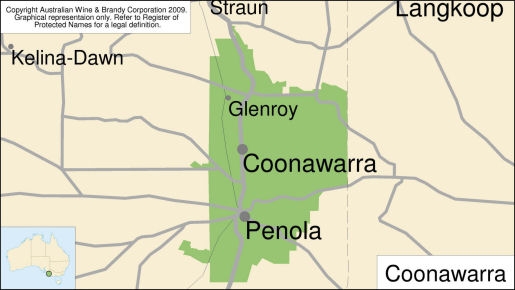
Coonawarra Wine Region
Climate
The region is only 60 kilometres (37 miles) inland and a predominantly maritime climate prevails, with the dry and moderately cool summers ripening most grape varieties to perfection. Its maritime location does not, however, prevent the occurrence of spring frosts that are occasionally quite severe. The extensive cloud cover that moderates the most important ripening period temperatures also sets the region apart from others.
Soil
To the untrained eye, Coonawarra appears completely flat, but in fact the red soil is situated on a slight but all important limestone ridge. It's no accident that the main road passes through its centre, marking the route followed by the bullock drays of the 19th century in their search for firm ground during winter and spring.
The terra rossa of Coonawarra is Australia's most famous soil, although it is not unique to the region (many parts of the Limestone Coast Zone have similar soils, hence its name), nor is it of volcanic origin, as some believe. Vivid red in colour, it is either friable subplastic clay or a shallow friable loam derived from and lying on top of a bed of soft limestone. There are two other soils present in the region. The first is the groundwater or black rendzina soil lying to the west of the limestone ridge. Because of its poor drainage this soil does not favour the production of quality red wine fruit. The other is the brown rendzina or "transitional", as it is called in the region. This is similar to terra rossa in all respects and is planted to red grapes quite successfully.
Wines
Chardonnay: With its vineyards situated on predominantly limestone substrata, Coonawarra seems eminently suited to this variety and, indeed, produces table wine of great quality and longevity. However, Chardonnay is still the "bridesmaid" in Coonawarra, with much of the tonnage being directed to sparkling wine. Some heavy oak treatment years ago tended to mask the quality of Chardonnay but, given its recent opportunity to emerge, the future looks promising.
Riesling: The quality of Riesling in Coonawarra has never been seriously in dispute. However, it has been so completely overshadowed by the reputation of the red wines, and increasingly by Chardonnay, that few producers have consistently made and released a quality Riesling. The fragrant, flowery and appealingly fruity style is increasingly gaining recognition.
Cabernet Sauvignon: Whatever yardstick one adopts, Coonawarra produces much of Australia's great Cabernet Sauvignon. The fruit flavours are very concentrated and luscious, covering a broad spectrum from black currant to plum to red cherry to prunes. Notwithstanding the impact of oak tannins, the wines are seldom astringent or tannic. Indeed, Coonawarra winemakers invest much effort in extracting every last grain of available tannin.
Shiraz: Shiraz was virtually the only wine grape grown in Coonawarra between 1900 and 1950, alongside just a few vines of Cabernet Sauvignon and a little Grenache. With the success of Cabernet Sauvignon, the grape that, in effect, created Coonawarra's reputation seemed to be taking a slow ride to obscurity until Wynns Coonawarra Estate turned the tide. The advent of the deluxe Michael Hermitage (Shiraz) alongside John Riddoch (Cabernet Sauvignon) has simply served to underscore the inherent quality of both varieties in the region.
Vital Statistics
| Map Coordinates | 37° 18' S |
|---|---|
| Altitude | 60 m (197 feet) |
| Heat degree days, Oct-Apr | 1430 (cut off at 19ºC (66.2ºF) but otherwise not adjusted) |
| Growing season rainfall, Oct-Apr | 220 mm (8.6 inches) |
| Mean January temperature | 19.6°C (67°F) |
| Relative humidity, Oct-Apr, 3 pm | Average 45% |
| Harvest | Early Mar - End Apr |