La Brea Fire Continues to Grow Unchecked


Steep, rugged terrain and nearly a century's worth of brush growth mean crews have their hands full fighting the nearly 15,000-acre blaze
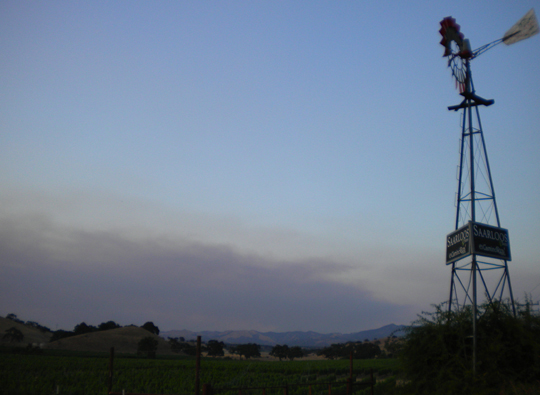
A cloud of smoke from the La Brea Fire drifts over the mountains northeast of Los Olivos just before sunset Monday evening. (Laurie Jervis / Noozhawk photo)
Crews are continuing to fight the La Brea Fire from the air and on the ground, but by late Monday, the remote blaze had burned nearly 15,000 acres of the San Rafael Wilderness.
The dense, 87-year-old chapparal and moderate to rapid rates of spread challenge firefighting efforts, fire officials said. Late Monday, the blaze, which was reported at 2:45 p.m. Saturday, had not entered the Sisquoc River area, and remained within the wilderness boundary.
As of Monday evening, the La Brea Fire had blackened 14,778 acres, and was zero percent contained. Personnel on scene totaled 1,052, according to officials.
California Interagency Incident Management Team 3, under Incident Commander Jeanne Pincha-Tulley, took command of the fire early Monday morning.
Crews on scene came from multiple agencies, including the U.S. Forest Service, the Santa Barbara County Fire Department, the Ventura County Fire Department, CAL FIRE, the Santa Barbara County Sheriff’s Department, Vandenberg Air Force Base, the National Park Service and the Bureau of Land Management. More crew members were expected to arrive on scene in the coming days, officials said.
As of Monday night, 23 engines, 34 crews, 17 bulldozers and seven helicopters were actively fighting the fire, officials said.
Officials urged motorists to use caution when traveling on Highway 166, as firefighting equipment continued to traverse the road to gain entrance to properties near the fire. Monday afternoon, fire activity near Timber Peak was clearly visible from Highway 166.
Crews and engines were attacking a “slop-over” portion of the fire on Sierra Ridge on Monday night, officials said, adding that existing dozer lines from the Zaca Fire along the Triplet Fuelbreak, and Peach Tree and Sierra Madre ridges were being utilized as fire lines.
Even though the fire is in a remote location and no homes or structures are threatened, agencies are pulling out all the stops to get the fire contained.
Forest Service fire management officer Dana D’Andrea told Noozhawk on Monday that he has worked in forests in Montana, where “lit burn’’ policies let naturally caused fires burn unchecked while fire officials keep watch to be sure the fires don’t threaten homes or structures. But because fires in Southern California have a history of covering miles of terrain within a matter of hours, D’Andrea said California firefighting agencies do not take any chances.
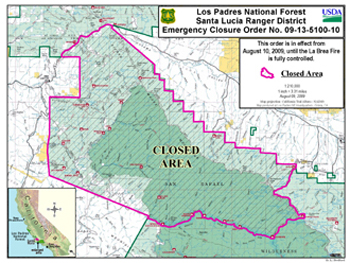
(Los Padres National Forest map)
“We in Southern California are bound to suppress all fires,” he said.
D’Andrea said the aircraft that ground observers see is being utilized in strategic locations, and that the fire is burning in vegetation that hasn’t burned since 1922. “You can’t even walk through this stuff,” he said, referring to the heavy undergrowth, and that the amount of chaparral requires air drops, as well as hand crews working on the fire lines.
The cause of the La Brea Fire remains unknown, he said, but there are old trails that permeate the canyon, and investigators are considering whether a hunter or camper accidentally started the blaze. Anyone with information about the cause is asked to call the La Brea Fire Tip Line at 805.686.5074.
Even with a lit burn that starts naturally, D’Andrea said, many restrictions on what suppression efforts can be implemented apply, especially during dry, hot spells.
“We took the most beating on the Jesusita Fire,” he said. “No one argued about where the fire was or what to send,” but the remote location of the fire caused the delayed response.
There’s a lot of cooperation among agencies that team up to fight fires, D’Andrea said, adding that the county sent its helicopter when the La Brea Fire first broke out and was the first piece of equipment on scene.
Typical August weather was forecast for the remainder of the week, with hot and dry conditions and temperatures from 80 to 90 degrees on the ridges to up to 100 degrees at lower elevations, officials said Monday night.
An emergency closure order was issued for portions of Los Padres National Forest in and around the fire. For more information, click here or call 805.681.5770.
Winemakers and grape growers in the eastern Santa Maria Valley kept tabs on the fire Monday, but weren’t overly worried about the falling ash — or the chance that the flames could damage the vineyards.
“At this time, there is very little concern about the fire reaching the vineyards in the eastern areas of the Santa Maria Valley,’’ said Kady Fleckenstein, executive director of Santa Maria Valley Wine Country, an association for growers, winemakers and wine-related businesses in the Santa Maria Valley.
“Managers will stay vigilant, but currently are not taking any precautions other than staying up-to-date with the latest news,’’ she said.
If the fire were to expand beyond the wilderness ares, the vineyards nearest its southern and western flanks, as the crow flies, are Colson Canyon Vineyard, Kenneth Volk Vineyards, Byron Vineyards & Winery, Bien Nacido Vineyards and North Canyon Vineyard.