Pass the Bottle
By Mark Godfrey 2009-8-18 9:40:38


 |
| Chinafotopress |
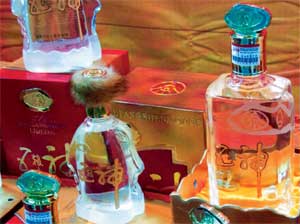
The retro, steel-grey stenciling on royal blue labeling recalls the look and feel of old Shanghai, but this belies the fact that the product is a milestone in China’s drinks industry.
Produced by UK-based drinks conglomerate Di文章来源中国酒业新闻网ageo with its partner Shui Jing Fang (水井坊), Shanghai White may represent the first time a multinational alcohol beverages company launched a product with a local partner.
It’s an ambitious foray into one of the most valuable but least tapped markets in the world. There are significant challenges though – taxes are going up, and competition is getting fiercer. Companies who want a share of the pie need to become more ambitious and more creative.
GOLD RUSH
Several foreign investors have entered the Chinese market. Aside from selling international brands locally, foreign drinks firms have been investing in local baijiu brands, most of which are state-owned.
Diageo — the world’s largest spirits producer by revenue — has a 43% stake in Quanxing (四川全兴酒业有限公司), a leading baijiu brand based in Sichuan Province, considered the home of baijiu. Sweden’s Vin & Sprit (V&S) — since acquired by Pernod Ricard — formed a joint venture with Jian Nan Chun (剑南春集团) back in 2007. In 2007, LVMH (Louis Vuitton, Moet Hennessy) bought a 55% stake in Sichuan-based Wenjun Distillery from the parent firm, Jian Nan Chun. LVMH, which also sells Hennessy cognac in China, has since hired an international design agency to repackage Wenjun’s baijiu products.
At the time of its 2007 JV with Jian Nan Chun, V&S said it hoped to grab a piece of the USD 19 billion dollar baijiu market. The market might be even larger than this, with research agency Euromonitor claiming that revenue from Chinese baijiu grew from USD 29 billion to USD 37 billion between 2006 and 2008. These figures mean that despite having next to no following outside of China, baijiu is the world’s most popular spirit by volume. 520 million nine-liter cases of the brew sold in 2008, compared to 497 million similarly-sized cases of second-placed vodka. Amid a global trend away from beer towards wine and spirits, the International Wine & Spirits Register calculates that 48% of global spirits are consumed in China and its three ‘BRIC’ counterparts – Brazil, Russian and India.
As a result, China has become a battlefield for the few multinationals that control most of the world’s recognizable drinks brands. Foreign spirits’ share of China’s imports remains tiny but the growth is impressive: according to the International Wine & Spirits Register (IWSR), imports into China went from 0.2% market share in 2003 to 0.8% in 2008. The UK-based Gin & Vodka Association, meanwhile, notes that its members’ imports into China rose 445% in 2008, compared to an 8.9% rise in gin shipments to the US.
BEWARE THE TAXMAN
China’s soaring spirits sales, coupled with the access that local partnerships can give to companies like Diageo, are all solid reasons for investing here.
However, a recent collapse in demand for premium baijiu may suggest investments by multinational drinks firms have been ill-timed. Enrico Perlo, general manager of Guala Closures China and a veteran of the Chinese spirits industry — his company provides the seals and corks for many of them — says the global economic malaise this year crushed sales of premium baijiu during Spring Festival, traditionally peak-season for brands like Maotai and Wuliangye.
Matters are made more complicated by recent tax hikes on alcohol. To replenish government coffers, China increased the tax on baijiu and cigarettes by 5%, raising it to 20%. By comparison, beer is taxed at just 5%.
China isn’t the only place contemplating higher alcohol taxes. The Marin Institute, a US-based international alcohol industry watchdog, has called for California to plug its budget deficit by raising taxes on alcohol. Scottish legislators have plans to introduce a minimum price on whisky, an effort targeted at low-price whiskies favored by problem drinkers in a bid to cut alcoholism. Given the scale at which spirits consumption in China is growing, it appears the country’s spirits industry is better placed than most to absorb a tax spike.
However, in this leaner economic climate, sales have leaned towards lower-priced products. At the budget end of the market, mass-market specialist Beijing Ergoutou (北京二锅头酒业有限公司) has had no trouble selling its RMB 10 bottles of baijiu. A company spokesman at the firm’s production facility, who declined to be named, said “sales are great” so far in 2009.
A recent shift to lower-priced products and competition from foreign brands seems to have triggered competition at the high end. Wang Lijun, head of Yunnan sales for Wuliangye (五粮液集团), says the demise of traditional local spirits, as reported in local media, is “really exaggerated.” But he’s less inclined to explain a Wuliangye pledge earlier this year to fold some of its lower-value brands in order to compete more forcefully with Maotai, surely this is a sign that competition at the high end is set to heat up.
STRONG HOME BREWS
Even if Spring Festival sales were down, argues Wang, owners of baijiu brands have plenty of cash after bumper years in 2007 and 2008. They also have strong market positions to grow on. Listed on the Shenzhen board, Wuliangye’s parent company, Sichuan Yibin Wuliangye Group (四川宜宾五粮液集团有限公司), reported an 8.2% increase on revenue in 2008 compared to 2007, with profits climbing 23.3% to USD 201 million. Wang points to thriving sales and price hikes on Wuliangye premium products to explain the figures.
Between 2003 and 2008 China’s drinkers paid RMB 112 billion to drink 200 billion liters of spirits, over 90% of which was baijiu. Sales rose 20% in 2007, and although the growth slowed to 10% last year there is more room for sales to climb, says Huang Li Ming, an alcoholic drinks analyst at Donguan Securities (东莞证券). He says the only clouds on the horizon are the high taxes.
In Sichuan, where the local spirits business enjoys the influence that being a top employer and tax payer brings, prices appear to have stayed static. Regional offices of the State Administration of Taxation seem to have been given room on when to apply the tax hike. Seasoned firms like Kweichow Moutai (贵州茅台酒股份有限公司), Sichuan Yibin Wuliangye Group and Yantai Changyu Group (烟台张裕葡萄酿酒股份有限公司) — all ranked by Euromonitor among China’s top ten baijiu makers — have done quite well throughout the crisis.
WHISKY & VODKA
Outside baijiu, whisky and vodka consumption is expected to show the fastest growth over the 2007 and 2012 period, however, these figures are still unlikely to threaten baijiu producers.
The big competitive advantage multinationals have over Chinese companies is their marketing budget. Zhaxian Mao, a baijiu expert at the China Institute of Food Science & Technology, thinks baijiu brands can use new investment to improve marketing, particularly to younger customers who have been seduced by western spirits’ advertising. “Most Chinese drinkers would never get the difference between a supermarket chain’s blended whisky and a premium single malt whisky,” he explains. “But there’s deep local knowledge to distinguish local spirits.”
A DIFFICULT MARKET
Foreign investors may bring novelty products, such as Shanghai White, but won’t be serious players, says Donguan Securities’ Huang, “since most of the best brands are all state owned.” Beer and soft drinks firms, he explains, “are much more open to outside investment.”
Sales of foreign spirits may be rising by 30-40%, but the percentage of overall spirits sales held by foreign firms will grow very slowly say most local analysts. “It won’t go to 5% anytime soon, if it grows it will maybe hit 2% or 2.1% in 2010,” says Liu Yuan, secretary general of the China National Alcoholic Drinks Circulation Association.
Wilfred Kwok, proprietor of Glen, Beijing’s first dedicated whisky bar, says traditional baijiu brands are unlikely to be displaced by imported spirits because “they’ve become so good at blending to suit Chinese food far better than other spirits.” He’s hopeful, however, that the sour, grain-based taste of whisky will appeal to baijiu drinkers more and more.
Whether domestic or international brands dominate the market in the long term, it is clear that the party won’t stop – and baijiu is still the flavor of the day.
转载此文章请注明文章来源 中国酒业新闻网。
From 中国酒业新闻网