Macedon Ranges


Overview
The Macedon Ranges region continues to grow far more quickly than one would imagine. The beauty and lifestyle of the area, together with its proximity to Melbourne, are all factors contributing to its success. In the context of much of mainland Australia, this is a totally atypical wine region; downright chilly in its windswept south-east and only marginally warmer in its north-west.
The Big Picture
The Macedon Ranges region is Australia's coolest wine area. Uniquely suited to the production of ultra premium sparkling wine, it also manages to produce table wines from Riesling, through Chardonnay and Pinot Noir, to Shiraz, Merlot and Cabernet Sauvignon. The size of the wineries is small and is likely to remain so. It is hard to imagine any of the larger wine companies moving in and this, at the end of the day, is exactly how the vignerons of the area wish it to be.
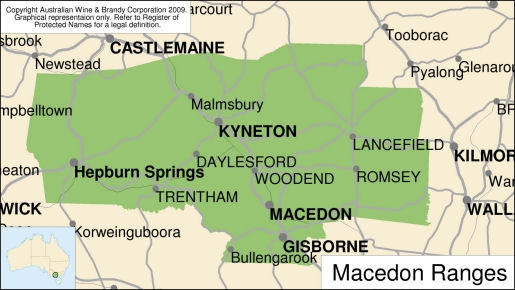
Macedon Ranges Wine Region
Climate
This sprawling, hilly and windswept area extends from the Lancefield-Macedon district at its southern end to the Kyneton district to the north. It is what might be termed the sharp end of Australian cool climate viticulture. Site selection (altitude, protection from wind and spring frosts, and maximum sun interception from north and north-east facing slopes), the careful matching of site and grape variety, razor sharp canopy management and relatively low yields are all prerequisites for success. Even then success will not come every year; those few extra degrees of heat as well as extra hours of sunshine of the warmer Melbourne summers are needed to get the best results.
Soil
The majority of the soils are relatively skeletal mountain soils, most typically granitic sandy loams which further restrict yields. However, there are patches of deep loams in valleys and on the lower slopes and occasional plains. Relatively low yields are in fact a blessing in disguise, for in many years higher yields would not ripen past sparkling wine levels.
Wines
Chardonnay: Fine, elegant, lightly structured and potentially long lived wines, sometimes showing a quartzy minerally goût de terroir which can be expected from plantings on and around Mount Macedon. The warmer years give fuller flavoured styles, as do the warmer sites in the lower altitude and more northerly parts of the region, where greater complexity is achieved.
Riesling: While not statistically impressive, this grape produces some of the region’s best white wine, with fine, intense, lime juice aroma and flavour in a distinctly Germanic style that ages wonderfully well.
Cabernet Sauvignon and Blends: It may be surprising, but as the plantings attest, this is an important variety. Its greatest expression is as a blended wine with either Shiraz or Merlot, but it also thrives in warm years as a single varietal.
Pinot Noir: Pinot Noir is used to produce both sparkling and table wines, arguably with equal success. Here the logic of the match of climate and wine style is immediately obvious, with both old and new arrivals producing wines of unimpeachable varietal character. Fine and tending to be lighter bodied in style in the cooler vintages, yet more robust and "chunky" in those of warmer years, these are wines of exceptional merit in the overall scheme of Australian Pinots.
Shiraz: Given that this is a relatively late ripening variety, generally found in warm to hot regions where it is considered to do best, it may come as a surprise to learn that the north of the region is eminently suitable for Shiraz. After all, despite the difference in soils, Heathcote, immediately to the north of Macedon Ranges, was one of the first regions to introduce consumers to the striking pepper, spice, liquorice and black cherry aromas and flavours of genuinely cool climate Shiraz. This style has added a third dimension to Shiraz in Australia.
Sparkling Wine: The preponderance of Chardonnay and Pinot Noir in the vineyards confirms the suggestion made by climatic statistics that this is an extremely good region for the production of sparkling wine. There are a number of high profile boutique brands within the region and the leading makers have been prepared to use the full range of techniques to produce wines with great character and individuality. The intense flavours and high natural acidity of the base wines encourage the use of avant garde winemaking processes, and the winemakers have been quick to respond.
Vital Statistics
| Map Coordinates | 37° 25´ S |
|---|---|
| Altitude | 300-700 m (984 - 2296 feet) |
| Heat degree days, Oct-Apr | 970-1050 (cut off at 19º C (66.2ºF) but otherwise not adjusted) |
| Growing season rainfall, Oct-Apr | 290-370 mm (11.4-14.5 inches) |
| Mean January temperature | 17.2-18.5º C (63-65.3º F) |
| Relative humidity, Oct-Apr, 3 pm, | Average 51% |
| Harvest | Mid Mar-early June |