Sunbury


Overview
Sunbury, near Melbourne, is one of Victoria's oldest wine regions, having produced wine since the 1860s. Historically the principal grape variety is Shiraz, but Chardonnay, Riesling, Semillon, Traminer, Pinot Noir, Cabernet Sauvignon and some Italian varieties also are grown.
The Big Picture
Sunbury includes the deep valleys and steep hills around Melbourne Airport, remnant indigenous grasslands at the eastern edge of the world’s greatest volcanic plain, and the slopes of rolling foothills. The best grapegrowing areas are found on these downhill slopes, some steeper than others.
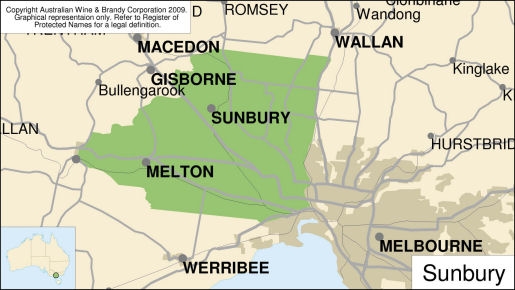
Sunbury Wine Region
Climate
Though appearing quite temperate, the climate during the growing season is much influenced by the cooling winds that blow over the plain. The nearby Macedon Ranges to the north and the sea to the south also exercise their respective cooling influences. Rainfall, though comparatively meagre at 549 mm (33.5 inches), is slightly spring-summer dominant, October through April at 334 mm (20.4 inches), but irrigation is essential in most sites. One might expect spring frosts to be a major problem, but they are no more extreme here than in the Macedon Ranges and their existence simply reinforces the importance of appropriate site selection.
Soil
The soils are typically dark and, except on the old alluvial river terraces, not particularly fertile. Their depth and structure varies significantly from lower level plains to hillsides.
Wines
Chardonnay: Unlike the Macedon Ranges, most of the Chardonnay grown in this region is used to make table wine. As one would expect given the cool climate, the style is elegant with good natural acidity. With a touch of Yarra Valley elegance, the resulting wines are not dissimilar to those of Geelong, a region with which Sunbury has much in common.
Semillon: Not widely grown, but in spirit and in performance this is a logical mate to Shiraz, with which it shares a preference for warmer, drier vintages. It has produced one or two quite memorable wines that combine varietal flavour with satisfyingly full mouthfeel.
Shiraz: Without question, the Shiraz is the noblest grape for the region even though, paradoxically, only Craiglee has given the grape a concentrated focus. It produces wines with a splendid array of black pepper, spice and black cherry aromas and flavours. As it is seldom more than medium bodied, the wine can be deceptively light, the alcohol level is seldom much beyond 12.5° and the tannins are typically soft and fine. There seems no logical reason why the best vintages should not age as well as the 1872 vintage which, after all, was produced from relatively young vines and had quite a low alcohol level.
Pinot Noir: This presents yet another paradox, as one would have expected more Pinot Noir to be grown and made in the region. The 1996 vintage showed what could be achieved with the grape, and it seems logical that local plantings should increase in the years ahead.
Cabernet Franc: The more common variety in the region is Cabernet Sauvignon, but the performance of each variety suggests that in most vintages it is too cold for Cabernet Sauvignon and that Cabernet Franc (the red grape of the cool Loire Valley in France) is better suited here.
Vital Statistics
| Map Coordinates | 37° 45S |
|---|---|
| Altitude | 275 m (902 feet) |
| Heat degree days, Oct-Apr | 1478 (cut off at 19ºC (66.2ºF) but otherwise not adjusted) |
| Growing season rainfall, Oct-Apr | 334 mm (13 inches) |
| Mean January temperature | 19.2°C (66.5°F) |
| Harvest | Late Mar - early May |