Pyrenees


Overview
Vines were first planted in this region in 1848 and after 150 years of fitful development the Pyrenees has finally assumed its proper role as an important producer of full-bodied red wines based on Cabernet Sauvignon and Shiraz. This has come thanks to existing wineries – the biggest being the Blue Pyrenees Estate with 177 hectares (437 acres) – and major vineyard developments, such as the Glenlofty Vineyard (Fosters Wine Estate) development at Elmhurst.
Chardonnay also does well, producing wines of considerable complexity, and is joined by Sauvignon Blanc in cooler vintages.
The Big Picture
The name of the region suggests dramatic mountains whereas, in fact, there are modest slopes and gentle, discrete valleys and sub-valleys. It is a picturesque area, with many differing vistas. The altitude of the vineyards varies from 203 metres to 460 metres (666 to 1509 feet).
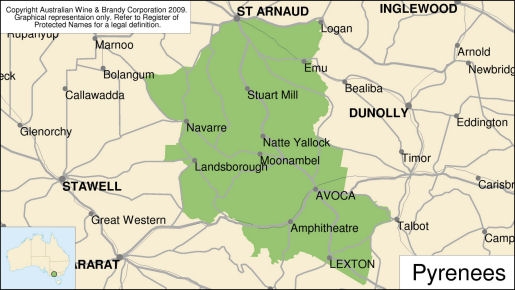
Pyrenees Wine Region
Climate
The net result of a series of countervailing influences is a temperate climate ideally suited to the production of full-bodied dry red wines. While the inland location gives rise to low midsummer relative humidity and to substantial diurnal temperature ranges in spring and early summer, late summer peak temperatures are lower than one would expect. This, in turn, is reflected in the region's lower than expected heat summation. Sunshine hours are generous; growing season rainfall is, however, limited, making irrigation all but essential. White and sparkling wines now contribute to the reputation of the region. Commonwealth Scientific and Industrial Research Organisation (CSIRO) research has highlighted that microclimates do exist in the Pyrenees and that the south, which is temperate to cool, is in fact only marginally warmer than Coonawarra.
Soil
The soils are the common grey-brown and brown loamy sands and sandy loams, though tending to be heavy. They are improved by the addition of gypsum and lime. Vine vigour is moderate, as are yields, and both factors contribute to the undoubted quality and strength of the red wines. Red sandstones are also present and are suitable for flavoursome white or sparkling wines.
Wines
Shiraz: Once again Shiraz demonstrates just how suited it is to the climate and terroir of western Victoria. As with Cabernet, gloriously sweet and rich fruit flavours are to be found in abundance, sometimes circumscribed by tannins needing to soften, but sometimes not. Pepper and spice occasionally appear, but more frequently red and black cherry and dark chocolate are the descriptors of choice.
Cabernet Sauvignon: The wine produced from Cabernet Sauvignon is never less than substantial and, at times, attains awesome proportions. Some of the wines are more tannic than others but all possess a sumptuously rich mid palate, with flavours running from eucalypt mint through to black currant as well as the earthy characters that develop during maturation.
Sparkling Wines: The Blue Pyrenees Estate continues to be a significant producer of sparkling wine, having developed specific new microclimate sites in cooperation with Charles Heidsieck and Piper Heidsieck. Taltarni, too, produces sparkling wine and the region is featuring its own distinctive styles.
Sauvignon Blanc: Produced by a number of makers, Sauvignon Blanc in the cooler years is showing distinctive varietal character.
Vital Statistics
| Map Coordinates | 37° 09'S |
|---|---|
| Altitude | 220-375 m (722-1230 ft) |
| Heat degree days, Oct-Apr | 1530 (cut off at 19ºC (66.2ºF) but otherwise not adjusted) |
| Growing season rainfall, Oct-Apr | 220 mm (8.6 inches) |
| Mean January temperature | 20.9°C (69.6°F) |
| Relative humidity, Oct-Apr, 9 am | Average 65% |
| Harvest | Late Feb-late Apr |