Grampians


Overview
Nowhere in Victoria is the link between gold and wine more pronounced, and nowhere are the legacies of the 19th century miners more impressive, than in the 1.6 kilometres (1 mile) of underground drives that run through Seppelt's Great Western, having been excavated by hand by unemployed miners after the gold had run out. Vineyards planted in 1867 include grape varieties so rare that several have defied all attempts at identification and are, in all probability, the sole surviving examples in the world.
The Big Picture
The landscape of the Grampians wine region is dominated by one of Victoria’s greatest land features, the Grampians National Park. Just two hours' drive west from Melbourne, the region offers a diverse range of activities for all tourists as well as the wine enthusiast. This is primarily a red wine area, producing wines with a rare combination of elegance and power and an exceptional capacity to age. The cellar doors range from state-of-the-art and architect-designed to historical buildings rich with the traditions of a winemaking past.
These strong traditions are carried today by a new breed of highly skilled and enthusiastic winemakers whose efforts respect the legacy of pioneers such as Hans Irvine, legends such as Colin Preece and today’s living legends, Viv Thomson, Ian McKenzie and Trevor Mast.
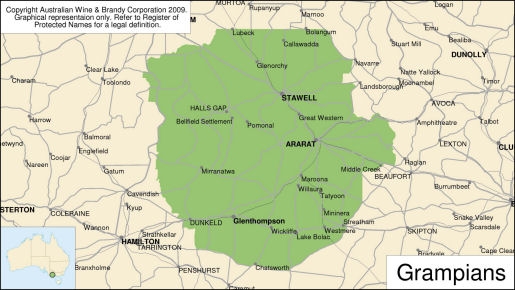
Grampians Wine Region
Climate
The climate of the region is of a Mediterranean type, the proximity to the Southern Ocean (between 100-200kms) providing a cooling influence during summer. Recognised as a cooler climate grapegrowing region, the growing season in summer is characterised by warm to hot days, but with nights that are cool to cold. Autumn is mild and reliably produces the most pleasant weather, perfect for ripening grapes in benign conditions. The region is especially well suited to later ripening red varieties, particularly Shiraz.
Soil
There are two principal soil types. The first group includes quite acidic grey and grey-brown loamy sands and clay loam soils; the second comprises a hard yellow soil with structured clay subsoils, which is also quite acidic and requires lime adjustment. None of of these soils is especially fertile and unless the pH is significantly increased with the addition of lime and/or gypsum, this will militate against vine vigour and restrict crop levels.
Wines
Chardonnay: This is sparingly grown and made, a situation that pays tribute to the quality of the Shiraz (and the Cabernet Sauvignon) rather than indicating any shortcoming in the quality of the Chardonnay. What is made and released is moderately intense, with a mix of citrus, white peach and cashew nut flavours.
Riesling: The style shows tropical lime juice aroma and flavour in the warmer years, with reserved, toasty wines in the cooler vintages.
Cabernet Sauvignon: Often blended with Shiraz (and other varieties), Cabernet Sauvignon performs well in adverse conditions and wonderfully when everything goes right. The black currant, blackberry and even raspberry flavours run riot without threatening the elegant, regional style of the wine.
Shiraz: This is the district's finest wine. The impact of mesoclimate conditions is greater than one might expect, for the style ranges from an almost understated silky smooth, with red cherry and plum flavours, through to strikingly concentrated wines, redolent with spice, pepper, liquorice and game. Yet, however diverse the fruit flavours may be, there is a common thread in their elegance and fine tannins, no doubt deriving from the cool conditions under which the grapes have ripened. Another unifying force has been the willingness of the winemakers of the region to let the character of the fruit express itself without too strong an influence of American oak.
Vital Statistics
| Map Coordinates | 37°09'S |
|---|---|
| Altitude | 240-440 m (787-1444 feet) |
| Heat degree days, Oct-Apr | 1460 (cut off at 19ºC (66.2 ºF) but otherwise not adjusted) |
| Growing season rainfall, Oct-Apr | 240 mm (9.4 inches) |
| Mean January temperature | 20.2°C (68.3°F) |
| Relative humidity, Oct-Apr, 3 pm | Average 45% |
| Harvest | Mid Mar-mid May |