Henty


Overview
Henty is the new name for what was previously termed the Far South West or Drumborg. Viticulture was pioneered in 1964 by Karl Seppelt, who accurately conceived it as an ideal cool region for the production of sparkling and delicate, aromatic wines.
The Big Picture
This is undulating terrain and prime grazing country, long famous – like much of western Victoria – for the quality of its wool. Protection from the wind, which exacerbates the effects of cold temperatures at flowering, is an important consideration and leads to the selection of sheltered north and north-east facing slopes wherever possible, or at least the cultivation of windbreaks.
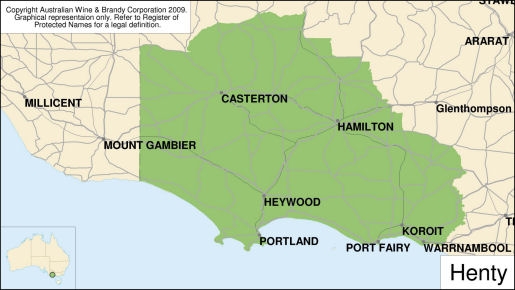
Henty Wine Region
Climate
Together with the Macedon Ranges, this is the coolest of the wine growing regions on the Australian mainland and has presented local vignerons with the experience, unusual in Australia, of producing quality wines from grapes grown in quite cold temperatures. The ample number of sunshine hours results in a growing regime not unlike that of the Canterbury Plains of the south island of New Zealand or northern European climates such as the Rhine Valley and Burgundy. In common with those areas, Henty is beginning to make a distinct impression with varieties such as Riesling, Pinot Noir and Chardonnay.
Soil
The vineyards are most widely planted on Cobboboonee Basalt soils: weathered basalt with gravelly loam topsoil overlying red clay. More recent plantings have variously utilised rich black volcanic clays, maritime sandy loam over limestone, and patches of terra rossa over limestone.
Wines
Chardonnay: Wines of a northern French character are starting to be produced, with typical linden lime aromatics and fresh palates with lively acidity.
Riesling: Arguably the best suited grape for the making of table wine (although there has been a handful of extraordinary Gewürztraminers made by Seppelt), Riesling is made by all the wineries in the region. Fine, intense, gently lime-accented wines gradually assume toastier characteristics as they develop in bottle over a decade or more, but they do not lose their hallmark elegance. If the volume (or the number of wineries) was greater, this region would likely rank with Australia's best. The occasional Botrytised Riesling simply adds lustre to the overall performance of Riesling here; once again elegance and intensity combine to produce a wine of exceptional quality.
Cabernet Sauvignon: The vintage conditions have to be favourable, but when they are Cabernet (either alone or blended with Merlot and/or Cabernet Franc) is produced with striking similarities to a classified-growth Bordeaux (from the Haut Medoc); sometimes redolent of cassis, or otherwise tending more to cedar and cigar box. One or two varietal Merlots (produced in miniscule quantities) have also been very exciting. All the wines in this family age particularly well.
Pinot Noir: Around Hamilton, the vines of this variety are still very young although, as with Chardonnay, they show much promise.
Sparkling Wines: The three classic grape varieties of Champagne – Chardonnay, Pinot Noir and Pinot Meunier – account for more than half the total plantings and are largely directed to Seppelt sparkling wine making. The release of a single, regionally-designated wine is rare.
Vital Statistics
| Map Coordinates | 38°21' S |
|---|---|
| Altitude | 15-100 m (49-328 feet) |
| Heat degree days, Oct-Apr | 1204 (cut off at 19ºC (66.2ºF) but otherwise not adjusted) |
| Growing season rainfall | 300 mm (11.8 inches) |
| Mean January temperature | 17.7°C (64.5°F) |
| Relative humidity, Oct-Apr, 9 am | Average 76% |
| Harvest | Mid Mar-mid May |