Grüner and Cabernet Franc, the new eastern royalty?


Food & Wine magazine isn't typically viewed as guide for eastern viticulture. Nevertheless a 2000 article prompted the tiny, upstart Galen Glen Vineyard and Winery in eastern Pennsylvania to become a Grüner Veltliner pioneer.
|
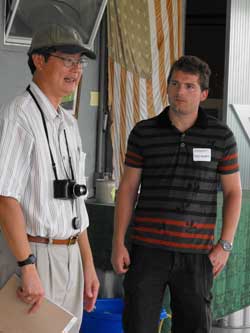
DSCF1392: Penn State University Viticulture Extension Educator March Chien, left, introduces Herbert Zillinger, a winegrower from Austria, at a gathering of eastern growers interested in Gruner Veltliner.
|
Winemaker Sarah Troxell thought the Austrian white variety would be "interesting" and not unlike the track records of aromatic varieties. After three years of persuasion, her vineyard manager/ husband Galen Troxell planted it. Six years and two vintages later, her unconventional hunch proved sound and wine made from their few acres has become a critical success at competitions and among peers.
Galen Glen's experience and other encouraging results with the Austrian white grape prompted the Pennsylvania Quality Assurance Group, a vinifera- only winery association, and the Pennsylvania Association of Winegrowers to explore the now-trendy Grüner and reconsider an eastern fixture: Cabernet Franc. Some view this Austrian-French combo as future royalty of eastern vinifera.
Finding Grüner vines in 2003 wasn't easy. The Troxells got plants from Amberg Nursery in New York. Galen Troxell doesn't overstate its performance in the vineyard. When asked about disease resistance and cold heartiness, the prevailing concerns in the east, he replies flatly "It's vinifera." He waits for "aromatic ripeness" and picked his 2008 crop at 21 Brix , waiting until early October. Sarah Troxell ferments the Grüner with some skin contact and hyper-oxidizes, clarifying by flotation.
Galen Glen found a great style with its Grüner, showing generous fruit and spice, rich mouthfeel and clean acidity, coming across as an American interpretation of the grape often dubbed "austere." At an industry tasting, their fruity and spicy style showed well alongside Austrian counterparts. Meanwhile, other growers still grope for the right approach. Black Ankle Vineyards in Mount Airy, Md., planted its Grüner in 2004 with vines propagated from budwood of two UC Davis vines. Owner Ed Boyce described vine growth as "spindly," aspiring to be a bush, but fairly easy to train. He and his vineyard consultant, Lucie Morton, found Grüner somewhat resistance to rot, possibly due to the grape's loose clusters.
Boyce's wine spends time in neutral oak and steel barrels and is aged on lees. His 2007, hampered by equipment issues, suffers from atypical aging. His grapefruity 2008 comes off as a Sauvignon Blanc, lacking the pear and white pepper spice characteristic of Grüner.
"We have not figured GV out yet," Boyce said, adding he's had better results with Albariño. "We are still in the wrong style."
Veteran southeastern Pennsylvania grower John Weygandt, whose Grüner vines prepare to deliver their first crop, said the range of eastern styles -- from aromatic and unctuous to austere and Sauvignon-like -- shows the grape responds to viticultural and cellar practices. "We have just started," he said. "We don't have to apologize for being austere."
He would not use oak at all, however, saying it could suppress Grüner aromatics and produce an "ersatz chardonnay."
Austrian winegrower Herbert Zillinger of the Wiental region spent a few days in Pennsylvania talking about "GVs", which in his accented English sounded like "chewies." Zillinger was not pleased with the Pendelbogen-trained Grüner vineyard he visited in Pennsylvania, which he termed over-cropped, with double the yield per vine of even inexpensive Austrian wines. The lack of under-vine cultivation, difficult with the Bangladesh-like rainfall in the east this growing season, harbors moisture that can cause disease, he noted.
Revisiting Franc
After much hype, Cabernet Franc became the red vinifera dog that wouldn't hunt. Cornell promoted it for its cold hardiness and early ripening. Yet many of the wines turned out to be mediocre or objectionably green. Growers were ready to write Cabernet Franc off and opt to remain victims in abusive relationships with prima donnas such as Cabernet Sauvignon and Merlot. Soul searching, and a few brutal winters, brought them back to the comely Cabernet Franc, which they stuck in the worst parts of the vineyards and neglected, allowing out-of-control canopies and overcropping, problems compounded by California clones on vigorous rootstocks.
As part of the second look at Cabernet Franc, Justin Scheiner, a Cornell University Ph.D. candidate, shared tips for slaying the green menace, 3-isobutyl-2-methoxy-pyrazine, or IBMP, associated with herbaceous and bell pepper character. While considered part of some grapes' varietal profile, in Eastern Cabernet Franc, this character often runs amok.
The post-harvest regime that reduces or masks IBMP after harvest include careful destemming since most IBMP are in the rachis, and processes such as thermovinification, oaking, and micro-oxigenation.
Focus is better turned to the vineyard. Canopy control is de rigueur. Scheiner's evidence confirmed that leaf removal -- at berry set and 30 and 50 days after -- exposes clusters to light and helps cut IBMP. Crop thinning, as early as possible, is essential. Wait too long, and thinning will neither reduce IBMP nor hasten ripening. Also, the further a cluster is from the cordon, the greater the IBMPs.
Scheiner upset conventional wisdom with this shocker -- crop load and vigor have no direct relationship to IBMP. Vine balance, the old saw-horse of 1 lb of pruning weight for 1 lb of yield, does correlate directly with IBMP reduction. Limiting an extremely vigorous vine to a very small crop isn't going to spare your wine from IBMP. "People don't believe me," Scheiner said. "I have to show them my slides."
The best way to limit vigor is before planting, by selecting the proper clone and rootstock to match the soil. Virginia-based Morton convinced many to remove their still-young CA2 clones on vigorous rootstocks embrace Cabernet Franc clones such as 214, 623, and 327.
"What's lacking in the east is complexity," she said. "One way to get it is by using multiple rootstocks and multiple clones."
Adam McTaggert, a winemaker at Boxwood Vineyards in Virginia, a Morton client, described 214 as producing wines with dark fruit and anise and 327 as spicy with white pepper notes. They blend theirs with other Bordeaux varieties.
As eastern winemakers shape an identity and style more look to Cabernet Franc from the cooler more analogous middle Loire Valley of France as a benchmark.