Grape Variety Field Trial Expands


San Joaquin Valley project includes 70-plus varieties
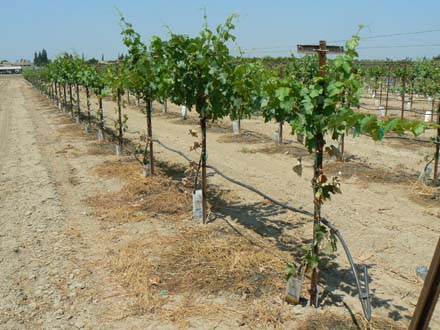
Phase 2 of the experiment includes 57 imported European varieties that are expected to produce high quality grapes in the San Joaquin Valley.
Parlier, Calif. -- Phase 2 of a field trial to evaluate winegrape varieties for quality and economic suitability in the San Joaquin Valley was installed this spring at the University of California's Kearney Agriculture Center in Fresno County, expanding the overall vineyard trial to more than 70 different varieties. UC Davis Cooperative Extension viticulture specialist Dr. Jim Wolpert, who is conducting the trial with UCD viticulture research associate Dr. Mike Anderson, described the research project during a field tour last week at the Kearney Ag Center's "Grape Day 2009."
Phase 2 of the trial includes 57 different varieties, primarily from Spain, Portugal, Italy and Southern France. Many were recently certified and released for use in the United States from the UCD Foundation Plant Services (FPS) National Grapevine Importation and Clean Stock Facility. The scion varieties were field budded this spring onto 1103P rootstock that was planted in 2008 in a 1.4 acre block. Wolpert said that the number of Phase 2 cultivars is a measure of the success of the FPS importation program. "The pipeline of new material coming out of FPS at Davis has been stuffed with an average of 40 to 60 new winegrape varieties or clones per year in recent years," Wolpert said. "A good number of these varieties in the trial have probably never been evaluated in California before." (Or at least, probably not with certified clean plant material.)
|
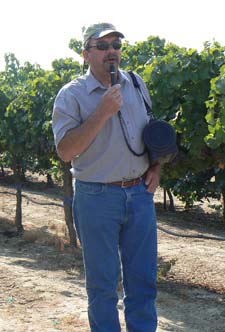
Jim Wolpert shows off the field trial vineyards at Parlier, Calif. |
Although many varieties were selected for the trial based on their history in warmer growing locations and potential for success in the San Joaquin Valley's climate, Wolpert said that is not necessarily true for every variety in the trial. "We are giving everything a chance to show its stuff," he said, noting that the variety Barbera is commonly grown in a cooler region in Italy, but has demonstrated it can do well in the San Joaquin Valley.
Phase 1 of the trial is in a separate block with 1103P rootstock planted in 2003 and budded in 2004 with 20 different red varieties. The project is being supported by the American Vineyard Foundation, the USDA Viticulture Consortium West, the California Competitive Grant Program, and with assistance from FPS and commercial nurseries Sunridge Nurseries and NovaVine.
San Joaquin Valley growers and vintners hope the trial results will provide them with more choices to plant higher quality grapes and produce higher quality wines. Wolpert noted that some historically successful varieties grown in the San Joaquin Valley -- whites such as French Colombard and Chenin Blanc, and reds such as Grenache and Carignane -- have declined in acreage due to less interest in generic wines, and because of the move toward varietal-labeled wines.
However, the more popular varietal wines such as Chardonnay, Merlot and Cabernet Sauvignon are not as recognized for quality when grown in the San Joaquin Valley, as compared with California's coastal regions.
The trial is intended to serve two purposes. An initial focus is to evaluate the characteristics of the varieties, such as color, tannin, acid and sugar content, and what they can add to the 25% of the blend in popular varietal-labeled wines to make a better flavor profile and enhance competitiveness for the California appellation varietal wines that are sold nationally.
"The national market generally demands fruit-forward wines with recognizable varietal names, so maybe there's something here to blend with and enhance a Cabernet Sauvignon, Merlot or Zinfandel," Wolpert said.
The second purpose of the trial is to identify newly available cultivars that grow well in the San Joaquin Valley that could potentially stand on their own as a varietal wine. Wolpert explained that consumers generally don't quickly accept unknown and new varietals, particularly with difficult to pronounce names. However, varietals such as Syrah and Pinot Grigio have had significant increases in production and consumption in the U.S. in recent years, rising from relative obscurity not long ago.
Phase 1 Varieties and Data
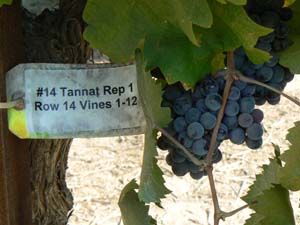 A Tannat vine and its ID tag. |
Some varieties, such as Syrah, Durif, and Tempranillo, already are grown in the San Joaquin Valley and can produce quality varietal wines. Grenache has historically been used in generic wines, but the trial includes different clones that became available more recently.
Viticultural data used for evaluation in the trial started with the 2007 season. Data collected include: yield at harvest, cluster weight, berries per cluster, berry weight, number of clusters per vine, clusters per vine with rot or shrivel, shoot number, clusters per shoot and pruning weights. At harvest, measurements were taken for Brix, TA, pH and for total anthocyanin and total tannin using the Adams-Harbertson method. Wolpert noted that yield also will be an important factor in determining economic viability of these varieties for growers.
In 2008, Constellation Wines' Mission Bell Winery in nearby Madera, Calif., donated services to make wines for nine of the varieties that produced sufficient amounts of useable fruit at harvest. Although data and sensory descrip tions for the wines have yet to be compiled, several varieties have shown low juice pH at harvest, an indication of promise for retaining good acidity for wine balance. These include Aglianico, Freisa, Grenache Noir and Tannat that have had a pH of 3.5 or lower.
Wolpert observed, "We are particularly interested in Italian varieties because they seem, by and large, to have plenty of acid, and it would be a useful characteristic if we didn't have to make acid adjustments in the winery." Wines will continue to be produced annually at Constellation in Madera, including for Phase 2 grapes in the next few years, and Wolpert indicated that winemaking data and tasting notes may be available in the future.
Phase 2 Varieties
Varieties in the new Phase 2 block are listed below, grouped by country of origin and by white or red variety.
Italy
Whites: Arneis, Biancolella, Coda di Volpe, Cortese, Erbaluce, Falanghina, Forastera, Malvasia Bianca, Perera, Picolit, Ribolla Gialla, Tocai Friulano, Trebbiano Toscano, Vernaccia, Greco di Tufo, Moscato Giallo.
Reds: Bonarda, Ciliegiolo, Corvina Veronese, Mammolo, Rondinella, Sagrantino, Schioppettino, Teroldego, Vespolina.
Spain
Whites: Albillo Mayor, Albillo Real, Parellada, Verdejo.
Reds: Garnacha Tinta, Graciano, Juan Garcia, Morrastel, Prieto Picudo.
Portugal
Whites: Alvarinho, Arinto, Viozinho.
Reds: Donzillinho, Mourisco de Semente, Periquita, Touriga Brasilieira, Trincadeira Preta.
France
Whites: Marsanne, Rousanne, Biancu Gentile, Petit Manseng.
Reds: Carmenere, Counoise, Arinarnoa, Caladoc, Ederena, Marselan, Nielluccio, Segalin, Semebat.
The Phase 2 block includes two other reds -- Pinotage from South Africa and Plavina from Croatia. Future phases and more varieties will be added in the future if funding is available, and if there is continued interest from growers.