Reconditioned wine barrels save money and the planet


|
|
So it's no surprise that so many winemakers are starting to recondition and reuse their wine barrels.
A typical French oak barrel cost $1,400 and has a life expectancy of about 5 years. After that it loses the ability to temper its contents.
For years, the use of reconditioned barrels was scorned by the industry for several reasons, not the least of which was the inconsistency by which they were reconditioned.
But like everything else in this world, reconditioning wine barrels has become a science. And as cost issues and calls for the industry to lessen its impact on the environment grow -- just like the use of artificial corks -- the practice of reconditioning barrels is becoming an accepted practice.
Like many of the new generation of winemakers, Rod Snapp of Javalina Leap Winery in Page Springs is a believer in both the cost savings and sustainability that reconditioned barrels offer.
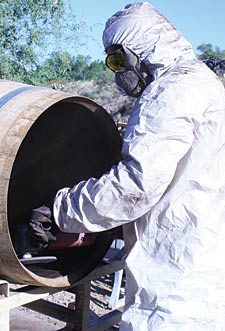
As he and a crew of pickers harvested his 2009 crop of zinfandel grapes this week, a barrel reconditioner imported from Napa Valley plied his trade on a concrete slab of the side of the winery.
To recondition a barrel takes a big hammer, a solid whack and the ability to disassemble the barrel without reducing it to a heap of stainless steel hoops and oak staves.
First the lid is removed and the wine sediments and layers of toasted oak are ground off its inside. Then a hazmat suit is donned and the reconditioner must crawl into the barrel to grind all the staves and the bottom.
Once the wood is cleaned, the process of toasting, roasting or charring the inside begins. The level to which the wood is treated depends on the individual winemaker and the type of wine the barrel will be used for.
Then it is reassembled, the hoops are hammered down and the barrel is once again made water- (or wine-) tight.
"It's the only way to go," Snapp says. "I like and the rest of the planet likes it."