China's Shangri-La is a real dream


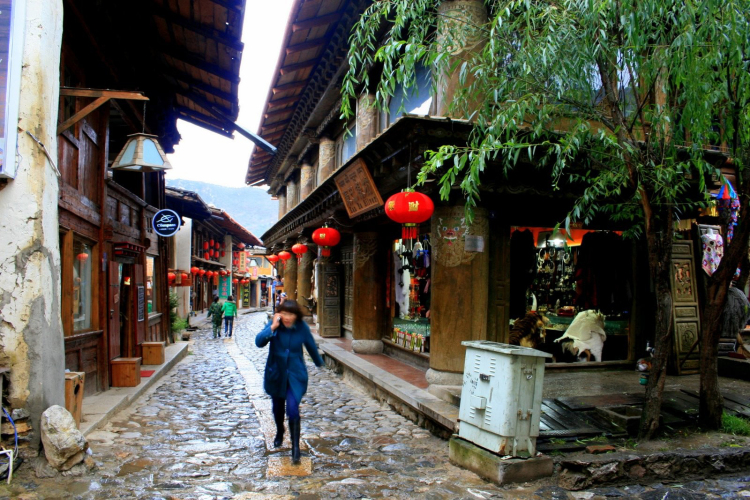
A street in China's officially recognized Shangri-La. (Photo by Ashley Colby / August 21, 2009)
Shangri-La, however, lies just outside the formal Tibet Autonomous Region but well within the plateau where Tibetans reside.
That culture is on display every evening when the people of the town gather in the main square, press "play" on a tape of Tibetan pop songs and start to dance. Women with magenta head scarves who seem to be the village elders lead the movement from the middle of a gigantic circle formed around them.
Shangri-La is split into areas known as Old Town and New Town. The quickly developing New Town houses most of the residents and resembles many nondescript Chinese cities -- rows of concrete storefronts selling everything from knock-off designer duds to live fish.
Old Town is a former stop along the old Tea and Horse Caravan Road, the route begun during the Middle Ages and across which Chinese tea was traded for Tibetan horses. The tiny original Old Town consists of a handful of cobbled streets lined with centuries-old traditional Tibetan wooden houses. It's no bigger than a square mile. Farm houses with first-floor barns are still tucked away at the edges of the town, pushed to the periphery by the encroaching tourist necessities: cafes, souvenir shops, art galleries and hotels.
Another big draw for tourists could be low prices. A double room at the Cobbler's Hill Old Inn, a reconstructed building from the Tea and Horse Caravan days, costs 100 yuan (about $15) a night. Our room overlooking one of the livelier streets in the Old Town was lined with dark wood and had a smartly designed bathroom, a desperately needed electric blanket (in October), TV with only Chinese-language channels and odd modern light fixtures.
A balcony gave us the opportunity to sit and watch the locals: Women in bright pink head scarves trudged up the hill, carrying huge loads of just-harvested greens in wicker baskets on their backs, while other women washed their long black hair in steaming sudsy saucers in the cold morning air -- a habit probably left over from the time just a few years earlier when there was no indoor plumbing in Shangri-La.
Food also is a bargain. At Tara Gallery & Cafe, a just-refurbished home from centuries past along the caravan route, we ordered the Indian meal ($7 per person) out of the choices of Chinese or the more expensive Tibetan Hot Pot. In the second-floor restaurant, we started on our six-course feast: Indian bean soup, potato curry, chicken curry and a large bowl of white rice for harnessing the vibrant flavors. Indian flat bread was accompanied by both a hot pepper and mild eggplant spread. Then there was just a glimpse into Tibetan food with fried yak cheese balls rolled in sugar. These melted in my mouth.
Next we headed to The Raven, just a few doors down the street from our hotel. Their best deal was a house red wine (about $9 a bottle). A place for hip locals and tourists of all kinds, it was lit by candles, and the walls were plastered with posters from New York rock concerts. Punk music blared on the stereo.
A little incongruous? Perhaps. I was a long way from the South Side of Chicago and totally immersed in the joys of discovery.
Although the low costs and vibrant and visible Tibetan culture would be reason enough to visit, the biggest draw might be the monastery a few miles out of town. On our second day in Shangri-La, the morning arrived with a sun that had been mostly absent for days. It was a perfect time to explore Ganden Sumtseling.
More than 300 years old and housing about 600 monks, this Tibetan Buddhist monastery is a place of great importance in the region. Throughout the monastery I found bright and newly redone frescoes (sometimes with English labels), 25-foot-tall statues of smiling Buddhas, golden adornments on the roofs of the temples, and red-robed monks moving from room to room, praying and lighting incense. The hills behind the monastery offer a commanding view of the entire complex, golden idols glinting in the afternoon sun, and Shangri-La in the distance in a valley surrounded by hills and several groupings of snowcapped peaks.
On my way out, an older monk placed a prayer necklace that he had made around my neck. Back in Old Town, I climbed a hill where I sat beside a giant prayer wheel to watch the sun set. Prayer wheels, a part of Tibetan Buddhist tradition, usually are cylinders on a spindle lined up in a row to be turned during meditation, meant to aid focus in reciting mantras.
I watched my first sunset in days looking over Shangri-La with prayer flags rustling in the wind overhead, bells tinkling and the smell of incense drifting from a nearby temple. In that instant, I realized I had discovered my own personal Shangri-La, a magical sense of calm and connection found in passing moments like this.