Yarra Valley


Overview
The Yarra Valley is Victoria's oldest wine region, has over 3,600 hectares under vine and crushes around 19,000 tonnes of grapes annually. It is also one of Victoria's most visited wine areas, located less than an hour's drive east of Melbourne's CBD or south-east of the airport.
The Big Picture
The Yarra Valley was Victoria's first wine growing district and has a history stretching back 170 years. Vines were first planted in 1838 and viticulture spread rapidly through the 1860s and 1870s. However, increased demand for fortified wine saw Yarra Valley wine production cease in 1921. Replanting began in the late 1960s and by the early 1990s the area under vine passed the high point of the 19th century. The Yarra Valley is now recognised as one of Australia's foremost cool climate regions, capable of making classic styles from a wide range of varieties. It is impossible to favour a single variety as the star performer because the Yarra Valley offers sparkling wine (including those made in partnership with French Champagne houses), fine Chardonnay, complex Pinot Noir, silky Shiraz and world-class Cabernet Sauvignon.
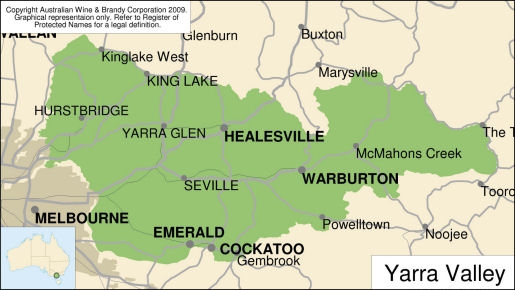
Yarra Valley Wine Region
Climate
The Yarra Valley is one of Australia's coolest regions, with elevation varying from 50m-400m. Rainfall is winter/spring dominant, with the summer relatively cool, dry and humid. There is limited maritime influence. The small diurnal temperature range reflects the proximity of the sea.
Harvest typically commences in early March with Pinot Noir and finishes with Cabernet Sauvignon in early May. Frost is rarely a problem, but can affect the lower vineyards on the valley floor from time to time.
With a seven-month growing season, rainfall of 750-950mm (often less rather than more) and restricted water holding capacity in some soils, irrigation is considered essential − although the extent of its use does vary significantly between producers.
Soil
There are two basic soil types. The traditional areas on the northern side of the valley are grey to grey-brown in colour on the surface and range from loamy sand to clay loam in consistency with red-brown clay subsoils, frequently impregnated with rock. Most are relatively acidic and low in fertility, but are generally well drained. The other major soil type is the immensely deep and fertile red volcanic soil to be found at Seville, Hoddles Creek and elsewhere on the southern (Warburton) side of the valley. Great care in cultivation should be taken with the latter soil type to devigorate vines planted in it, so that they produce fruit and not luxuriant foliage.
Wines
Chardonnay: The quality of Yarra Valley Chardonnay took longer to assert itself than did that of its Pinot Noir. Over the past ten years the quality and range of style has increased dramatically. While there is a distinctive regional melon, fig and white peach flavour substrate to all Yarra Valley Chardonnays, there is tremendous diversity in weight, texture and richness that partly reflects vintage variation and partly differing winemaking philosophies and techniques as well as vineyard terroir. What is undoubted is the capacity of the Yarra Valley to produce long-lived Chardonnay of the highest quality.
Sauvignon Blanc: Very little of this is grown, and demand is substantially in excess of valley-grown supply. The appetite of the wineries for Yarra Valley Sauvignon Blanc fruit remains undiminished. Even smaller quantities of Semillon are grown and, where available, are usually blended with Sauvignon Blanc to good effect.
Cabernet Sauvignon: As is the case on the Mornington Peninsula, Cabernet Sauvignon is usually blended with up to 20%, sometimes more, of Cabernet Franc and Merlot. The wines are invariably elegant and often deceptively forward but can vary from light-bodied through to full-bodied. The common feature is the softness of the tannins − they are almost silky. This can trap the unwary into assuming the wines will not cellar well, but they do.
Pinot Noir: Pinot Noir takes pride of place in the Yarra Valley as it has won the reputation of being one of Australia's renowned Pinot Noir regions. Slowly the essential nature of this difficult grape variety is becoming better understood. While many wine drinkers dismiss it because it is so different to that of Cabernet Sauvignon or Shiraz, others appreciate its haunting delicacy and surprising length of flavour. For those who understand true Burgundy (typically domaine-bottled), the strawberry plum spectrum of fruit flavours to be found in the Yarra is very exciting.
Shiraz: Shiraz is on the cusp in a climate that is neither too hot nor too cold, yet not perfect. This is a variety that is not to be toyed with in the Yarra, and so it is sparingly produced. Appropriate site selection is critical. The warm, north-facing slopes are highly desirable and capable of producing intensely coloured and flavoured wines, redolent of black cherry spice and pepper. They are never too extracted or alcoholic and have those fine, silky Yarra Valley tannins.
Vital Statistics
| Map Coordinates | 37° 49'S |
|---|---|
| Altitude | 50-400 m (164 - 1312 feet) |
| Heat degree days, Oct-Apr | 1250-1352 (cut off at 19ºC (66.2 ºF) but otherwise not adjusted) |
| Growing season rainfall, Oct-Apr | 400 mm (15.8inches) |
| Mean January temperature | 17.9-19.4°C (64.2-67°F) |
| Relative humidity, Oct-Apr, 3 pm | Average 55% |
| Harvest | Early Mar-Early May |