Gippsland


Overview
The Gippsland wine zone covers a large area extending from the NSW / Victorian border, along the coast to Wonthaggi just below Melbourne, then west to the edge of the Great Dividing Range. The zone sweeps along spectacular coastlines and through picturesque rolling hills.
The Big Picture
This burgeoning wine zone, though remote in parts and not as well known as some regions, produced fine table wines as far back as the 19th century, when the most notable vineyards were those of the Costellos and Louis Wuillemin in the Maffra-Bairnsdale area. Wine production ceased prior to the First World War and didn't reappear until the 1970s. Development has been slow, and is dominated by small, family owned vineyards and wineries.
Gippsland comprises three distinct geographic areas, with varying topography, soils and climate influencing the wine styles. South Gippsland, south of the Strzelecki Ranges down to Bass Strait, includes Phillip Island and Wilson's Promontory. A truly cool climate area, it is wetter and windier than other parts of Gippsland. It is traversed by the South Gippsland and Bass Highways.
West Gippsland, including the Gourmet Deli area around Warragul and the Latrobe Valley and surrounding hills, stretches as far as Rosedale in the east. Cooler than East Gippsland, it usually has a warm, dry autumn, which allows for the ripening of most grape varieties. It is traversed by the Princess Highway.
East Gippsland, beyond Rosedale, includes the cities of Sale, Bairnsdale and Lakes Entrance. A more Mediterranean style climate is experienced here, with lower rainfall than the rest of Gippsland. Also traversed by the Princes Highway.
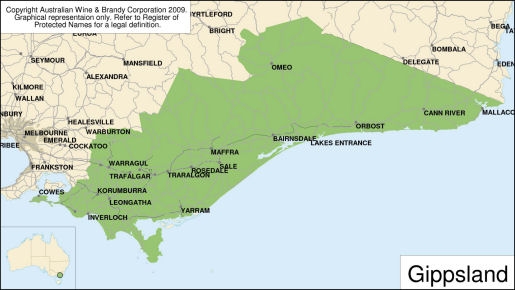
Gippsland Zone
Climate
The climate is influenced by the weather systems moving across the south of the continent from the west to the east. East Gippsland has the added complexity of systems moving down the coast from the north. Winter droughts are not uncommon in the east, as these two systems can block each other.
Soil
Soils vary significantly, ranging from dark black loams to lighter sandy soils in the grey to grey-brown spectrum with mottled, yellow to red clayey subsoils.
Wines
Chardonnay: Chardonnay is successfully made across Gippsland , but is most striking in East Gippsland, where low yields produce wines of wholly exceptional flavour, structure and overall impact. Immaculate and more conventionally structured and balanced Chardonnay is made in West Gippsland, with finer and more elegant versions in South Gippsland.
Pinot Noir: Varies somewhat throughout the zone, tending richer and somehow slightly more rustic in East and West Gippsland. South Gippsland Pinot Noir is regarded by some to be among Australia's greatest; fine and elegant, but with a deceptive length and intensity.
Cabernet Sauvignon and Merlot: These are usually but not invariably blended, doing best in parts of West Gippsland, but also in the East. By and large medium-bodied, the wines do best in warmer vintages.
Vital Statistics
| Map Coordinates |
37°30'S - 38°29'S |
|---|---|
| Altitude |
20-50m (66-164 feet) |
| Heat degree days, Oct-Apr | 1300 - 1470 (cut off at 19°C (66.2°F) but otherwise ot adjusted) |
| Growing season rainfall, Oct-Apr | 420 - 530mm (16.5-20.8 inches) |
| Mean January temperature | 18.1 - 19oC |
| Relative humidity, Oct-Apr, 3 pm | Average 45% |
| Harvest | Early Mar-end April |