Mornington Peninsula


Overview
Offering a unique combination of beaches, water sports and vineyards, and alive with tourist attractions, Mornington Peninsula is Victoria's answer to the Margaret River. Both regions have an extraordinary number of restaurants, many of them winery affiliated, and an abundance of accommodation in all styles. Although the wineries are relatively small, Mornington Peninsula's many different sites and mesoclimates produce an exotic array of wines.
The Big Picture
Wine production on the Mornington Peninsula dates back to 1886, when Dromana wine won an honourable mention in the Intercontinental Exhibition in London. Five years later, 14 Peninsula grape growers were mentioned in an Australian Royal Commission into the Fruit and Vegetable Industry. In the 1920s many of the region's vineyards were abandoned or uprooted. Seppelt and Seabrook operated a vineyard in Dromana in the 1950s that was destroyed by a bushfire in 1967.
In 1972 some aspiring vignerons independently recognised the potential of the Mornington Peninsula for producing high quality, cool climate varieties. These pioneers were quickly joined by others and the region now has 200 vineyards, 60 brands and around 50 cellar doors. Viticultural and winemaking experience and a highly developed professionalism have allowed vignerons to use their terroir to produce premium quality wines which are held in high regard.
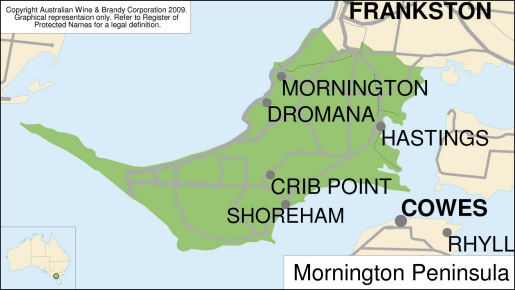
Mornington Peninsula Wine Region
Climate
Surrounded by Bass Strait, Port Phillip Bay and Western Port Bay, the Mornington Peninsula is one of Australia’s true maritime wine regions. In this part of the world, the prevailing wind is generally either from the north and west across Port Phillip Bay or from the south and east across Bass Strait.
Situated at a latitude of around 38°, it is also classified as a cool climate region. This unique combination allows particular wine styles to flourish without many of the problems sometimes associated with a cool climate.
The maritime influence provides relatively high summer humidity, vine stress is low, sunshine hours are abundant, and rainfall is plentiful during winter and spring. The coincidence of late ripening and a prolonged gentle autumn result in fully ripe grapes with outstanding fruit flavours, high natural acidity and fine tannins.
Soil
There are four principal soil types. Hard mottled yellow duplex soils with a very distinct break marked by a thin, acid cement/sand pan between the surface soil and the underlying friable, well-drained clay are to be found in the Dromana area. Around Red Hill and Main Ridge, red soils of volcanic origin (kraznozems) predominate; these are very deep and fertile. In the Merricks area there are brown duplex soils, while much sandier soils are in evidence at Moorooduc.
Wines
Chardonnay: This is the Mornington Peninsula's most noteworthy wine and one that, if made in the style favoured by most producers, is distinctively different to any other Chardonnay produced in Australia. The background fruit flavour is quite delicate, with flavours in the melon, citrus, fig spectrum. It is very sensitive to the influence of winemaking technique and, in particular, to the effect of malolactic fermentation. Partly through necessity, as natural acid levels are frequently quite high, and partly, it would seem, through peer group pressures, the majority of the wines are wholly or partially taken through the secondary malolactic fermentation and frequently barrel fermented. The net result is to overlay a strong nutty/cashew character. If sufficient underlying fruit is there, and it often is, the result is spectacularly good and equally distinctive.
Pinot Gris and Viognier: Viognier has been in the district for decades, while Pinot Gris is a more recent arrival. Pinot Gris has become a bistro favorite and somewhat of a regional signature wine in recent years.
Cabernet Sauvignon: Despite an early enthusiasm for this variety, it became apparent that much of the region is too cold for the satisfactory ripening of Cabernet Sauvignon. However, in warmer areas of lower elevation, especially around Moorooduc, Cabernet Sauvignon and its Bordeaux cousins, Cabernet Franc and Merlot, ripen extremely well. Many regional Cabernets are in fact blended with up to 15% Merlot and Cabernet Franc, a practice which accentuates the natural tendency to suppleness and elegance. The flavours can be intense if not downright piercing, running the full gamut of red into black berries, but the wines are never heavy and certainly not tannic.
Pinot Noir: There is enormous range, depth and style to the region's Pinot Noirs, from hauntingly delicate to intense and lingering. The constant factor is the clear varietal character. As the majority is at the lighter end of the spectrum, that varietal clarity is all the more pronounced. Such wines are best enjoyed within two or three years of vintage and are a fine advertisement for the variety.
Vital Statistics
| Mornington | |
|---|---|
| Map Coordinates | 38° 20'S |
| Altitude | 25-250m (82-820 feet) |
| Heat degree days, Oct-Apr | 1080-1570 (cut off at 19ºC (66.2ºF) but otherwise not adjusted) |
| Growing season rainfall | 320-386 mm (12.5-15.2 inches) |
| Mean January temperature | 18.8-20º C (66-68ºF) |
| Relative humidity, Oct-Apr, 3 pm | Average 55% |
| Harvest | End Mar-early June |