Geelong


Overview
Hand-crafted with passion and dedication, Geelong's elegant wines are the expression of a cool climate, rich soils and a unique history.
The Big Picture
The Geelong region has two histories. Victoria’s first commercial vintage was produced here by Swiss immigrant vignerons in 1845. However, from the 1870s, when phylloxera was discovered in some vines, there was a winemaking hiatus of nearly 100 years. Today, the region is again home to many boutique, family-owned vineyards, creating world-class varietal wines.
Low rainfall produces a rich concentration of flavour, aroma and colour – the distinctive regional characters of Geelong wines. It’s also a diverse region, with plenty of geographical "latitude". From the maritime breeze of the Bellarine to the dark volcanic topsoils of Moorabool and dry, rocky outcrops at Anakie, subregional nuances add complexity to the wines.
Common to the region is a natural passion for producing wine, by virtue of premium conditions and a diverse landscape, not to mention the unique people who are compelled to make their wine here.
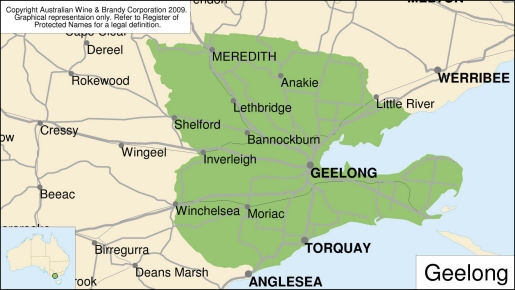
Geelong Wine Region
Climate
The region’s climate is cool, providing an extended ripening period. The majority of the area is strongly influenced by the moderating effect of the surrounding water of Port Philip Bay or Bass Strait. Pushing up into the northern part of the region the climate is less maritime and more Continental. Elevations are from the coast to approximately 400m above sea level. The region is fairly dry, with average rainfall between 500 ml and 600 ml per annum; the majority falls in winter and spring. Strong winds are a constant, providing good airflow within the canopy, which assists in the natural control of various vine diseases. The mean average January temperature is 19 degrees.
Soil
The principal soil type is the commonly encountered red-brown clay loam over a hard clay base. The subsoil varies in pH; in part it is strongly alkaline, owing to the presence of limestone, while elsewhere it is more acidic. A second soil type is also found, that of Biscay; black cracking clay, which forms a finely cracked surface crust.
Wines
Chardonnay: If the area under vine in Geelong is to substantially increase, Chardonnay will no doubt be one of the major contributors. It has shown it can produce a wine of exceptional strength and complexity, developing pronounced Burgundian overtones with age. It can also be made in a simpler and more easily accessible form on the Bellarine Peninsula. As with Pinot Noir, some of the newer plantings are being used to produce a sparkling wine base, and this is likely to continue.
Cabernet Sauvignon: The area is capable of producing concentrated, powerful and long-lived Cabernets with, at their best, intense black currant characteristics and less desirable, herbaceous ones at some sites in the cooler, wetter years. At all sites, limited yields are of prime importance in shaping the style and intensity of the wine.
Pinot Noir: During the last century, Pinot Noir was a famous wine for the region, and it is so again. Its producers carry disproportionate weight in the region, due in no small measure to the clarity of varietal expression and the sheer quality of the wine made from this most capricious of grapes. The styles of the wine are predictably very different, reflecting differing winemaking techniques and philosophies. One does not need flights of fancy to find plums, tobacco, violets, strawberries and truffles appearing, though not necessarily at the one time.
Shiraz: Geelong Shiraz wines, in favourable years, have strength, depth of colour, bouquet and flavour. Almost all wineries produce striking Shiraz. They sometimes show pepper and spice overtones but more often than not rely on potent dark cherry fruit with persistent though balanced tannins providing structure and longevity.
Vital Statistics
| Geelong | |
|---|---|
| Map Coordinates | 38° 07' S |
| Altitude | 20-150m (66-492 feet) |
| Heat degree days, Oct-Apr | 1470 (cut off at 19ºC (66.2 ºF) but otherwise not adjusted) |
| Growing season rainfall, Oct-Apr | 250 mm (9.8 inches) |
| Mean January temperature | 19.°C (66°F) |
| Relative humidity, Oct-Apr, 3 pm | Average 57% |
| Harvest | Early Mar-end Apr |