Curing Brand Australia Syndrome, Part 1


Australia’s regions are going through an identity crisis. More precisely, they’ve fallen victim to Brand Australia Syndrome. It’s not that Australia’s best regions aren’t capable of producing stellar wines with discernibly unique personalities. Rather they’ve all been dressed in the same wallaby-patterned outfit for so long that it’s become difficult for anyone to tell them apart.
The importance of regional differentiation, beyond country and brand name, is only just being realised by Australia’s producers. Regions that have not formed clear identities are struggling in today’s ultra-competitive markets. Wines from places that are mainly bereft of incumbent style, quality and price indicators leave today’s consumers nervous of spending a lot of money on an unfamiliar label. This creates a precarious situation whereby the ratings of iconic wine critics can become make-or-break for wineries.
Clearly defined regions lay critical marketing foundations for their resident producers. The very mention of Champagne, Napa Valley or Barolo conjures stylistic and quality images in the consumer’s mind. It sets a benchmark price point. The tangible benefits of achieving a high level of regional recognition are so powerful as to instil a premium on the cost of land within that delimited region and stabilise local grape prices.
Considering the precedents of wine regions around the world that have successfully differentiated themselves, I suspect that the cure for Brand Australia Syndrome lies in the efforts of the many individual producers. The old one-size-fits-all marketing focus needs to give way to demonstrating what’s unique about the liquid in each and every glass. Consumers should be able to taste not just Australia in a wine but Clare Valley or Coonawarra or Yarra Valley or Margaret River. Consequently, Australia’s wineries need to strive now more than ever to produce grapes and styles that demonstrate a sense of place, not concocting me-too wines that appeal to the whims of promiscuous mass markets.
From a critical point of view, I don’t believe that a wine’s ability to express regional typicity is an essential factor in assessing intrinsic quality, but that a wine speaks of a particular place and vintage certainly makes it more interesting and desirable to me as a consumer. And I don’t think I’m alone in this view. Generally speaking, consumers that are shopping for a new premium wine to buy will fast-track through colour, grape and country considerations, honing in on a special, delimited region that has a reputation, however brief, for quality and discernable terroir profile. When we wine-hunters crack open our new acquisition, we want to taste a new (and hopefully extraordinary) version of our regional and vintage expectations, not some market research inspired blend that consistently tastes of the same consistency. As Ralph Waldo Emerson said, “A foolish consistency is the hobgoblin of little minds...”
In Asia I’ve recently spotted a few commendable wineries that are making impressive inroads towards communicating regionality and curing Brand Australia Syndrome for their regions. In particular, there are a handful of Aussie winery pioneers that I’ve had the opportunity to meet up with in Singapore – ranging from the well established to the brand new – successfully highlighting the regional aspects of their wines while enhancing the reputations of their regions through the quality that they’re producing. This Part 1 of Curing Brand Australia Syndrome is based on a recent tasting I attended in Asia of Jim Barry’s unmistakably Clare Valley wines.
Jim Barry Winery, Clare Valley
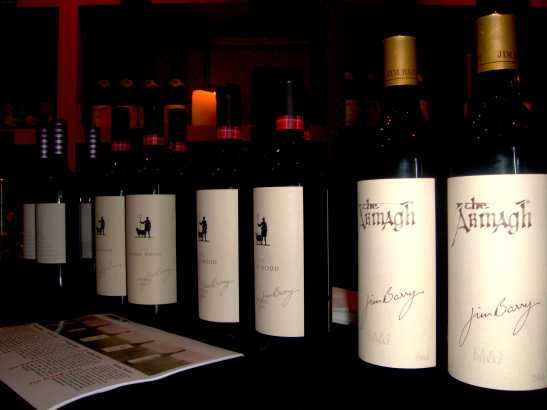
Clare Valley is a relatively small nugget of land under vine just north of the Barossa and its sub-regions (e.g. Eden Valley, Adelaide Hills and McLaren Vale). Because of its proximity, Clare often gets stylistically thrown into one big Barossa vicinity soup in the minds of consumers and even many wine experts. Yet there can be subtle climate/soil/altitude/site differences manifested in the less manipulated wines that set the Shirazes and Rieslings in particular apart from other regions. I maintain that if quality conscious wine consumers are able to get to grips with the stylistic differences between Hermitage and Cote Rotie, Clare and Barossa shouldn’t be too much of a stretch. Therefore for those that are truly interested in experiencing this distinction between the Clare Valley and Barossa, Jim Barry’s wines are an excellent place to start.
The Clare Valley is home to only around 50 wineries and is responsible for just 1-2% of Australia’s total wine production. Although the growing season can be warm to down-right hot, cooling breezes funnelled through the hills and the undulating terrain yielding dramatic variations in altitude play key roles in producing styles of wines that can appear to fetch from cooler climates than much of the Barossa. Soils are varied and are probably best considered on a vineyard-by-vineyard basis, but generally these can range from chocolaty loams and sandy gravels to Oz’s famous terra rossa in Watervale to slate based soils that can produce some stunning Rieslings around Polish River.
I met Peter Barry of Jim Barry Winery here in Singapore at a tasting he was hosting in the cellar of the Grand Hyatt Hotel in May 2009. Peter is no stranger to Asia. In 1983 he was one of the first internationals to make wine in China, in the Qingdao / Tsingtao area. “It was too frustrating at that time,” he hastened to add. “I could see China had potential but before someone can write the Bible, they gotta learn to read!” These days he travels to Asia communicating about his wines to key emerging markets. Singapore is his largest market in Asia followed by Hong Kong and Japan is just starting to happen as is Vietnam. Asia has become a key market for Jim Barry Wines – Peter is now selling as much wine to Asia as he is to the UK and the potential here for continued sales growth on the back of hard-graft marketing and education is clear.
Peter went on to tell me how his father, the eponymous winery’s Jim Barry, was a wine pioneer not just in Clare Valley but in Australia. In 1947 Jim Barry graduated from Roseworthy - only the 17th person in Australia to receive a diploma in winemaking. He was the first “qualified” winemaker to work in the Clare, setting up his winery in 1959. Peter took over the winery’s GM reins from his father in 1985. Although Jim passed away five years ago, he has forever left his fingerprint on what has become the inimitable style of this very special region.
The tasting commenced with the Jim Barry Lodge Hill Riesling 2008, a variety that has adapted so well to the region’s terroirs that the Clare Valley Riesling style has become a New World classic. In fact Clare Valley’s only real regional rival for top Rieslings in Australia is its neighbour, Eden Valley, sometimes labelled rather confusingly as Barossa Valley Riesling. I find the Eden Valley Rieslings to be just a touch more exotic and richer than Clare’s, a little weightier and more flamboyant with less minerals and finesse.
Jim Barry purchased the Lodge Hill vineyard back in 1977, convinced that by virtue of its high altitude (480 metres) it was destined to produce great Riesling. And true to what has since emerged as Clare Valley form, this is a bone dry, crisp, light to medium bodied style with tons of citrus fruits aroma / flavour intensity and packed with minerals. During production Peter avoids skin contact. “I don’t want any phenolics in the juice. I’m aiming for minerality. This wine won’t go petrol (since) this is a development of phenolics. My Rieslings go honeyed with age and after 20-30 years they can develop a marmalade character.”
The tasting then went exclusively Shiraz. I like how Peter Barry keeps his Shiraz range simple, producing just three clearly defined wines: The Lodge Hill, The McRae Wood and The Armagh. As with all wine produced under the Jim Barry label, these wines are 100% Clare Valley estate grown.
Akin to Shirazes from a few other regions in Australia such as the Barossa, the best Clare Valley examples tend to be big, rich, powerful wines. When the wines are really singing of their terroirs, usually I tend to find a little more perfume, violets and rose plus black pepper and exotic spices (cardamom, coriander seed, star anise, cinnamon) on Clare Valley wines vs pure warm blackberry and blackcurrant cordial with liquorice, black olive and dried Mediterranean herbs on many Barossa examples. Both regions can produce highly structured wines though to me a good Clare Valley Shiraz generally gives tannins that are more tightly knit, finely grained and silky textured than the more pronounced yet rounded, velvety Barossa tannins.
In 1985, the same year Peter Barry assumed management of the winery, he first developed the now iconic label, “The Armagh”. I’ll take a moment to make particular mention of this wine since it is truly an exceptional benchmark for Clare Valley Shiraz. Planted by Jim Barry in 1968, this small 3.3 hectare vineyard produces one of Australia’s classic old-vine, own-roots, single vineyard wines that really speak of its place. Indeed, wines like this should be made ambassadors for each and every delimited region in the country!
Peter Barry has seen a lot of changes to the Australian wine industry throughout the last 30 years, yet his winery has held true to the uniquely Clare Valley styles and traditions that his father Jim Barry helped to uncover and forge. If anyone doubts that the Clare Valley has its own identity, they need to look at these wines.
Jim Barry Wines are distributed in Singapore by Culina Pte Ltd., 24 Senoko Way, Singapore, 758046. Tel: (65) 6753 6966.
Tasting Notes
The Lodge Hill Riesling 2008
90 points
Very pale colour. Intense aromas of lime cordial, lemongrass, grapefruit and pineapple. The palate is bone dry and very minerally with a crisp backbone of acidity and a light to medium body. Long, chalky finish. Drink now to 2020+. Tasted May 2009.
The Lodge Hill Shiraz 2006
91 points
Medium garnet-purple colour. Very fruity, intense blackberry and mint aromas on the nose complimented by exotic spices – anise, cassia bud and cloves. Full bodied, concentrated palate with medium to high acidity and a medium level of silky tannins. Long finish with lingering notes of black pepper. Drink now to 2015. Tasted May 2009.
The McRae Wood Shiraz 2005
92 points
Medium to deep garnet purple. The nose is a little more subtle and fragrant than The Lodge Hill with notes of cinnamon, cardamom and eucalyptus complimenting a core of dark cherry and warm cassis fruitiness. On the palate the high level of acidity nicely balances the full body and rich, concentrated flavours. A medium level of very finely grained tannins provides seamless support. Long finish. Drink now to 2019. Tasted May 2009.
The McRae Wood Shiraz 1999
93 points
Medium garnet colour with a touch of brick in the rim. The nose provides evolved, earthy aromas with discernable notes of tobacco, leather, spice and smoked bacon over dried plum fruit. Medium to full bodied palate with complex layers of earth, dried fruit and spice flavours. Medium level of velvety tannins. Long finish. Drink now to 2013. Tasted May 2009.
The Armagh 2005
97 points
Deep garnet-purple colour. The nose is a little mute to begin but with a bit of coaxing reveals an elegant perfume of violets, cardamom, coriander seed and mint supplementing the freshly crushed blackberry and cassis fruit. The palate is powerful with a good dollop of oak that should integrate into the generous fruit given a little more time in bottle. Crisp acidity provides plenty of freshness and vitality. Medium+ level of very fine, silken tannins. Long layered finish. Drink 2010-2025+. Tasted May 2009.